Porpoise vs. Unicorn: Heraldic Attribution of the Baroque Cabinet and Architectural Armorials at Dybäck Castle in Skåne
Located in Skurup Municipality (Dybäcks slott), the estate has long been studied through its recorded succession of owners (Åberg, 1966; Slottsguiden, 2021). However, the unpublished armorial complex preserved both inside and outside the castle—anchored by an oak cabinet—serves as primary heraldic evidence that revises these established narratives.
Provenance of the Study & Scientific Novelty
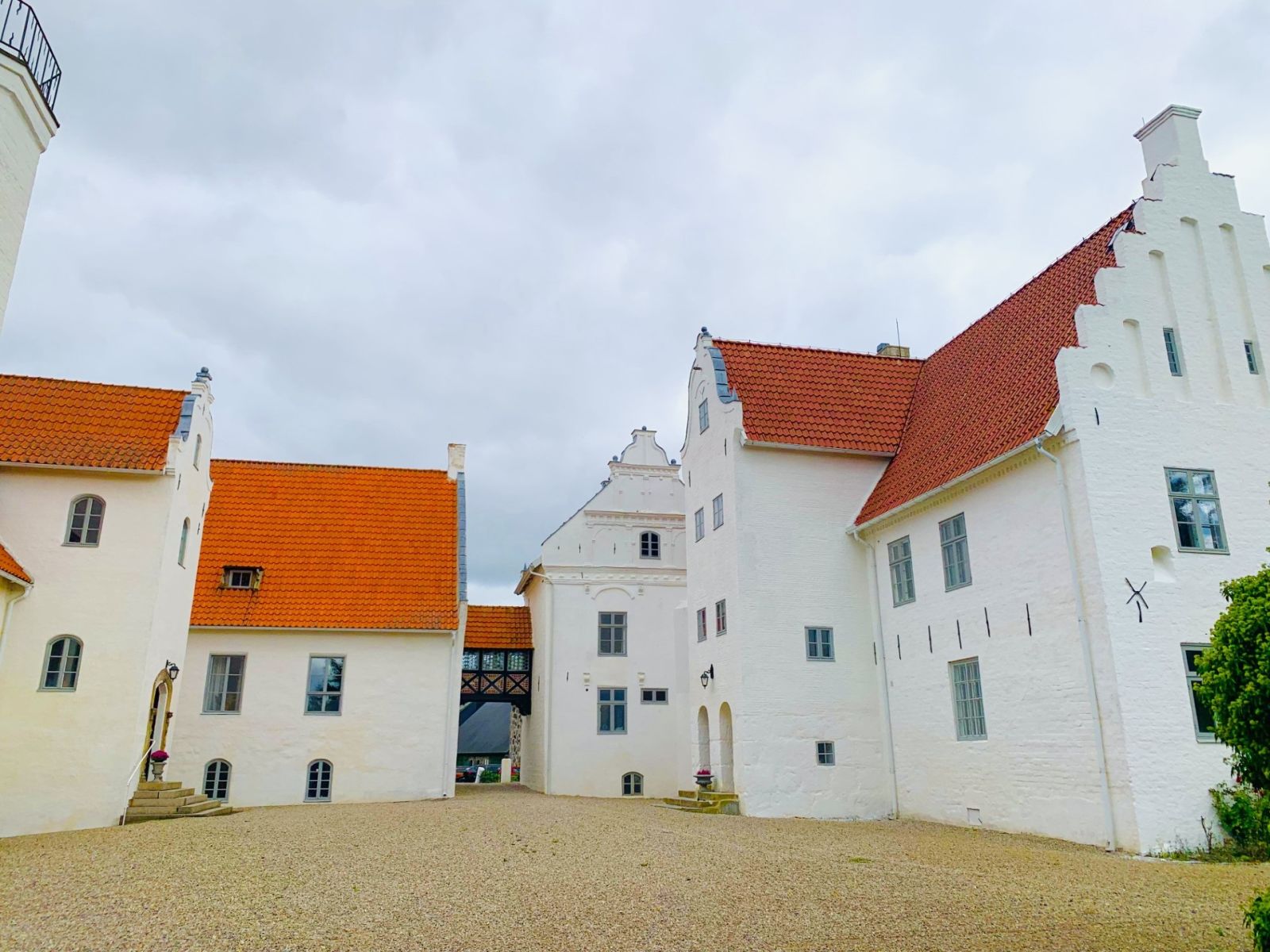
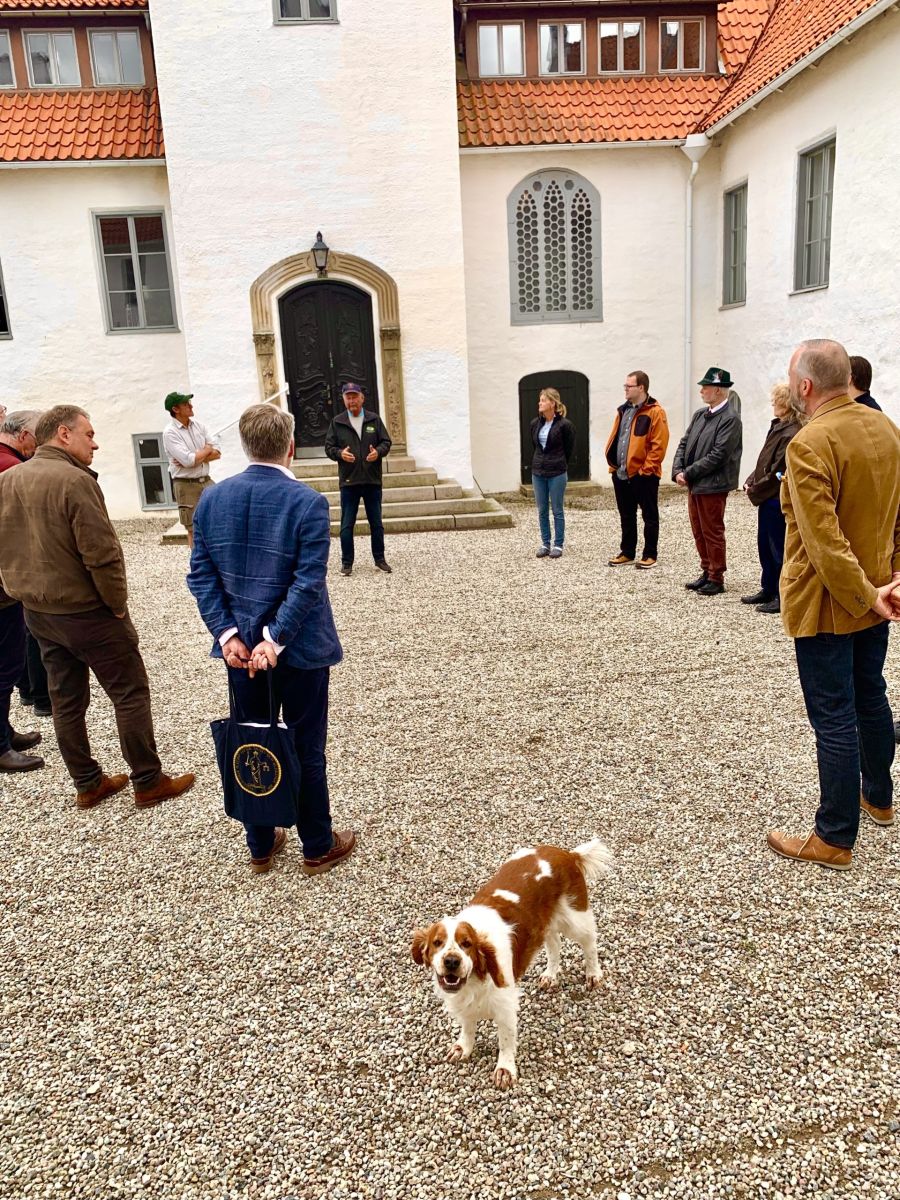
Because Dybäck Castle remains a private residence of the Alwén family—currently stewarded by Carl-Otto and Magnus Alwén—its interior artifacts have largely escaped academic cataloging (Haben, 2025). This study presents first-hand field documentation recorded by the author during the joint excursion of Svenska Heraldiska Föreningen and Societas Heraldica Lundensis (Utflykt till Dybäck slott) on September 6, 2026 (Armigers Report, 2026)
The Cabinet’s Heraldic Program vs. Recorded Owners of Dybäck
A critical comparison between the documented owners of Dybäck and the four pairs of alliance coats of arms on the Baroque oak cabinet reveals a striking discrepancy: the medieval Bing (red tower on silver) and Hollunger (three mill wheels) families, as well as the Brahe family (silver pale on black, introduced via Otte Marsvin’s 1604 marriage to Mette Pedersdatter Brahe), are completely absent from the furniture. Instead, the cabinet constitutes a Scandinavian Ahnentafel (ancestral table) displaying four pairs of paternal and maternal ancestors across generations. Following canonical heraldic convention, the panels are blazoned below from top to bottom and left to right (from the viewer's perspective), although it is specifically the inscribed lower panels that serve as the primary chronological and genealogical key to attributing the entire cabinet:
The "eared" Baroque panel moldings (verkröpfte Rahmen), golden chancellery cursive script, and the pre-1733 undivided Beck arms firmly date the cabinet to circa 1670–1710 (Åberg, 1966; Riddarhuset, 2026).
1. Upper Left Panel (Uninscribed — Alliance Arms of Berndt Simon Ingelotz and Anna Beata Lang, m. April 18, 1721)
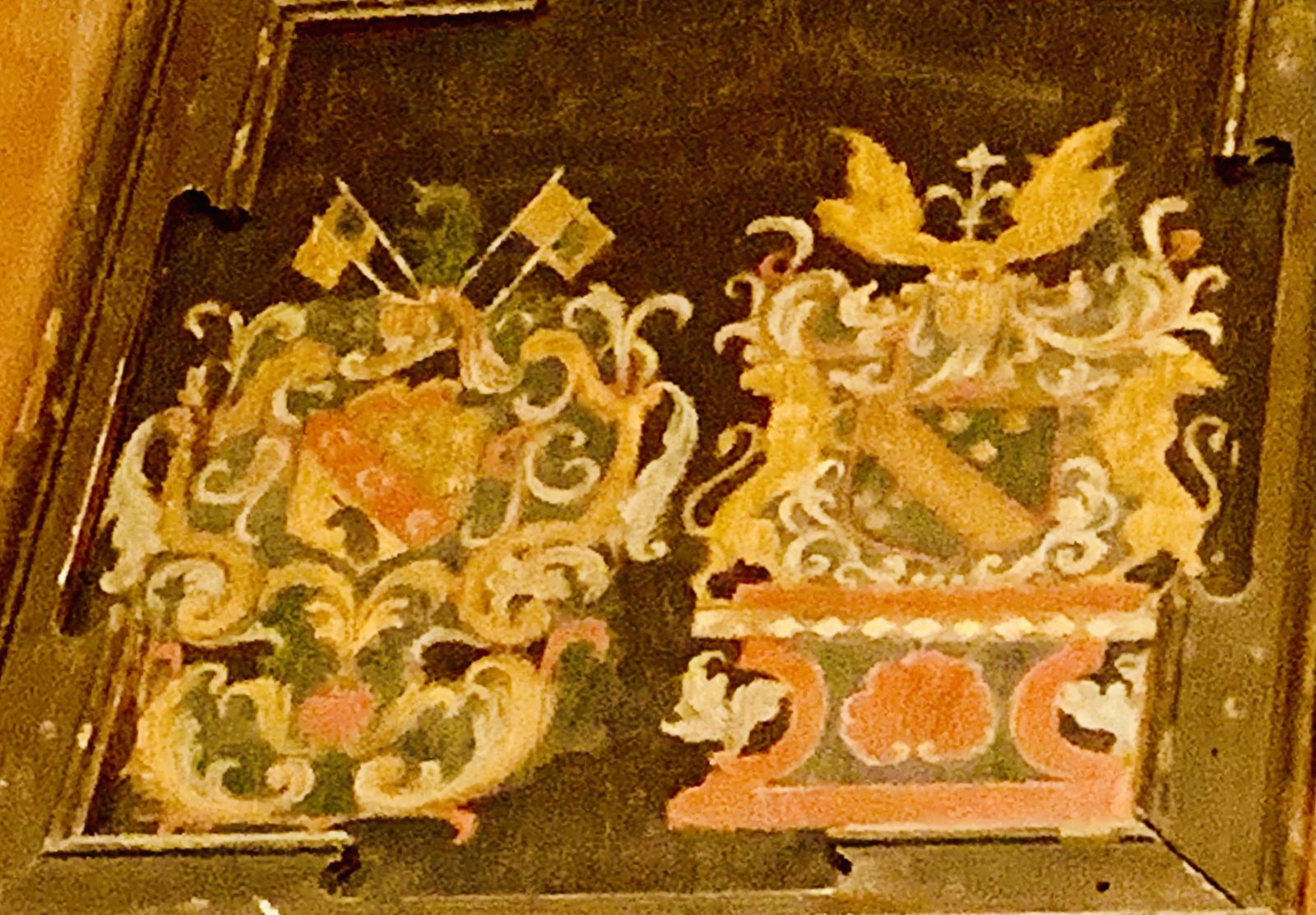
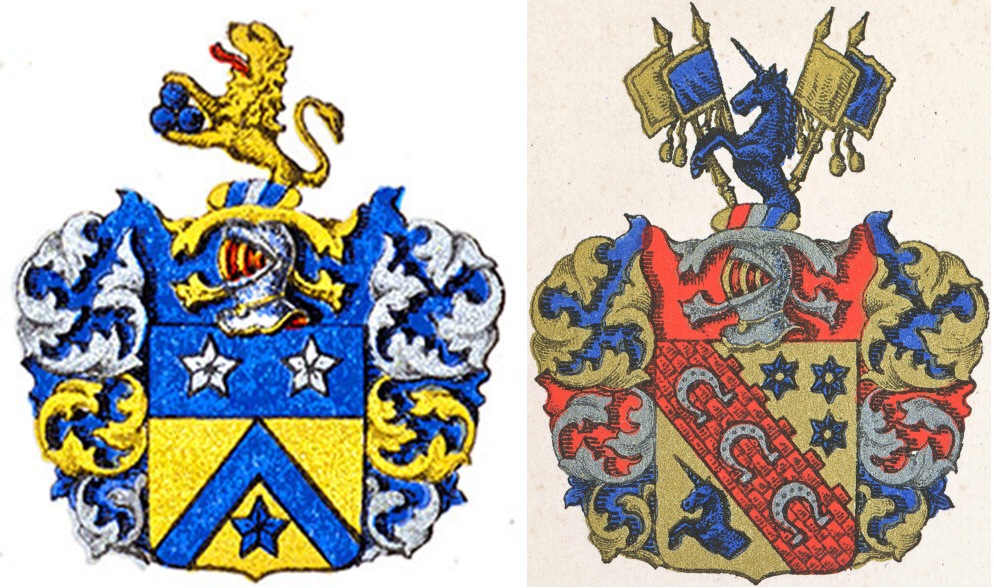
- Dexter (Husband — Major Berndt Simon Ingelotz, 1685–1765; Swedish nobility no. 1721, ennobled 1720): Or, on a bend gules three horseshoes argent (a canting cavalry motif recalling the Swedish noble family Hästesko), accompanied in the upper field by three six-pointed mullets (stars) arranged 2:1, and in the lower field by a blue (darkened to black on the panel) unicorn issuant. Crest: a blue (darkened to black on the panel) unicorn with a golden horn issues between two pairs of tournament standards (standarer), each pair consisting of one golden (Or) and one azure standard. Mantling: argent doubled Or (Elgenstierna, 1928, Vol. IV, p. 11).
- Sinister (Wife — Anna Beata Lang, 1684–1740; burgher patriciate of Helsingborg / Pomeranian origin): Sable (or darkened azure), a bend Or (or sable/argent variant) accompanied by six six-pointed mullets (stars) argent (or Or), three above and three below arranged along the bend in a 2:1 order. Crest: a crowned helm bearing a silver heraldic lily on a stem between a pair of open golden eagle wings (offener Flug). Mantling: argent doubled Or. Supporters & Pedestal: flanking the cartouche stand two golden lions turned outward away from the shield (abgewendet), resting upon a carved Baroque socle with red-terracotta volutes, a golden molding band, and a stylized shell/palmette in the center.
Heraldic and Genealogical Attribution of the Sinister Coat of Arms (Anna Beata Lang):
Anna Beata’s lineage accounts for both the burgher blazon and the aspirational Baroque framing of this escutcheon:
- Patrician Burgher Status: Anna Beata was the daughter of Bengt Lang, Mayor (borgmästare) of Helsingborg. Although his brother Johan Lang was ennobled in 1691 under the name Langenhielm (no. 1294; see Elgenstierna, 1928, Vol. IV, p. 502), Bengt himself remained within the non-noble urban patriciate (burgher estate).
- Pomeranian–Scanian Burgher Tradition: Originating from Stade in Swedish Pomerania, the unennobled administrative and mercantile branches of the Lang family maintained hereditary burgher arms (borgerliga släktvapen). A golden or dark field with a bend charged with/accompanied by stars and an eagle or open eagle wings in the crest is characteristic of German–Pomeranian burgher heraldry used by the Lang family in 17th–18th-century Scania.
- Exclusion of Related Noble Lines: Genealogical cross-checking rules out all adjacent family arms:
- It is not the arms of her mother, Catharina Elisabet Silnecker (Silnecker, no. 988 / 1214; Elgenstierna, 1932, Vol. VII, p. 226), which bore three golden acorns on an azure field.
- It is not the arms of her first husband, Major Gustaf Gyllenpamp (Gyllenpamp, no. 675; Elgenstierna, 1927, Vol. III, p. 317), which displayed an armored arm holding a sword.
- Nor is it the arms of Berndt Simon Ingelotz’s first wife, Gieska Christina Stobée (Stobée, no. 1439; Elgenstierna, 1932, Vol. VII, p. 689), whose shield was parted per bend with a lion.
- (Historical note: The western moiety of Dybäck Castle passed to the Ingelotz family in 1725 through Anna Beata Lang’s stepfather, Provincial Chamberlain Jacob Klerck, who had married her widowed mother Catharina Silnecker; see Historiskt-geografiskt och statistiskt lexikon öfver Sverige, 1860, Vol. II, p. 147).
2. Upper Right Panel (Uninscribed — Alliance Arms of Lt. Col. Christoffer Ehrensparre and Christina Gustaviana Ingelotz, m. at Dybäck Castle, January 8, 1740)
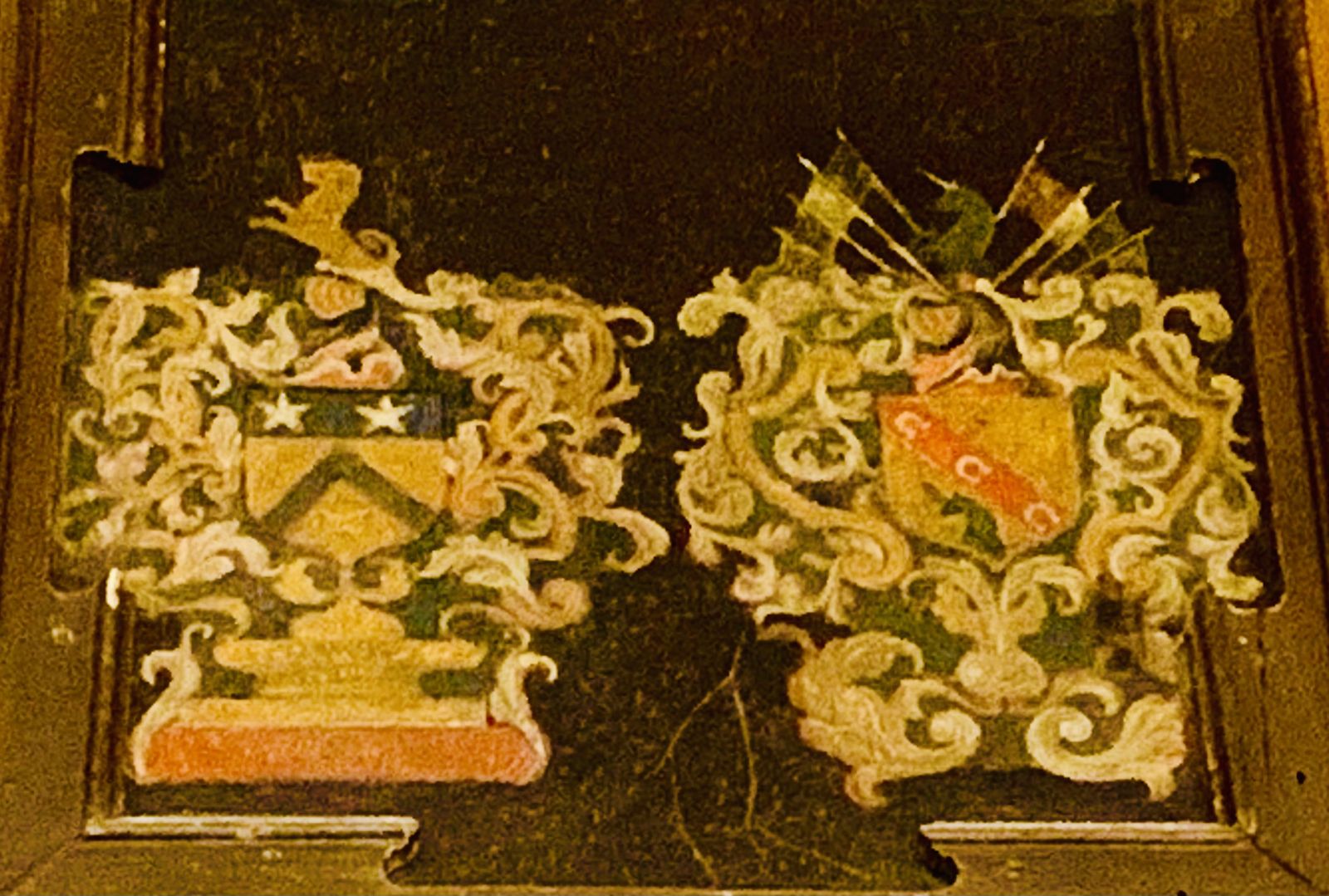
- Dexter (Husband — Lieutenant Colonel Christoffer Feif, ennobled Ehrensparre, d. 1767 at Dybäck; Swedish nobility no. 1694, ennobled 1719): Or (tarnished argent), a chevron sable (a canting sparre charge); on a chief sable two six-pointed mullets (stars) argent (originally tinctured azure, though the blue pigment on the panel has evidently darkened with age to appear sable). Crest: a crowned helm with a rising bird/falcon (en uppstigande fågel; stylized here akin to a golden lion/griffin issuant). Mantling: sable (originally azure) doubled Or/argent. Pedestal: the shield rests upon a carved Baroque architectural socle, serving as a visual marker of elevated martial and landed rank (Elgenstierna, 1926, Vol. II, p. 466).
- Sinister (Wife — Christina Gustaviana Ingelotz, 1722–1767; heiress of Dybäck): An exact repetition of the dexter coat of arms from the upper left panel—featuring the bend gules with three horseshoes argent, the three six-pointed stars (2:1) in chief, the black (originally blue) unicorn issuant in the lower field, and the black (originally blue) unicorn with a golden horn issuing between two pairs of tournament standards (each pair comprising one golden and one azure standard) in the crest (Elgenstierna, 1928, Vol. IV, p. 11). This direct recurrence illustrates a generational Ahnenprobe (ancestral lineage program): the upper and the black unicorn with a golden horn issues between the tournament standards in the crest (Elgenstierna, 1928, Vol. IV, p. 11). Rather than indicating Ahnenverlust (endogamous pedigree collapse), this direct recurrence illustrates a generational Ahnenprobe (ancestral lineage program): the upper right panel commemorates the 1740 marriage of the cabinet's commissioners—Christoffer Ehrensparre and Christina Gustaviana Ingelotz—while the upper left panel displays the arms of the bride's parents (Berndt Simon Ingelotz and Anna Beata Lang).
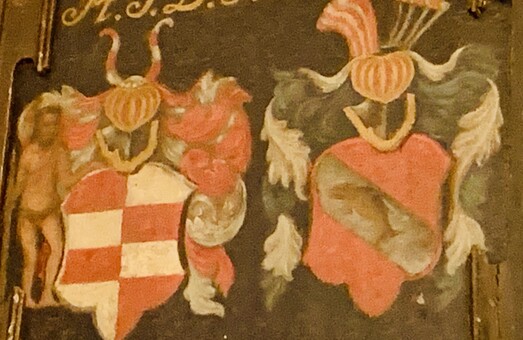
3. Lower Left Panel (H. J. B. F. O. M. W. — Bille & Marsvin)
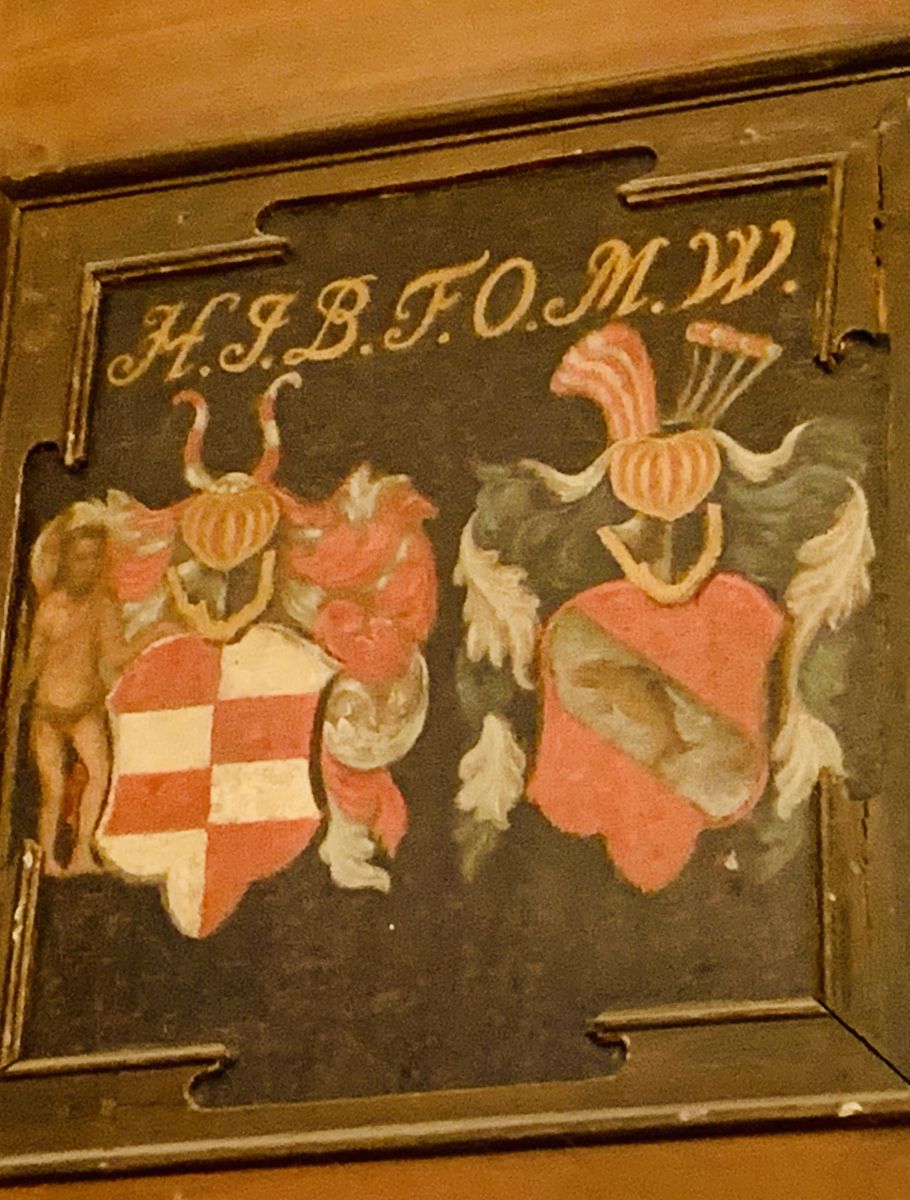
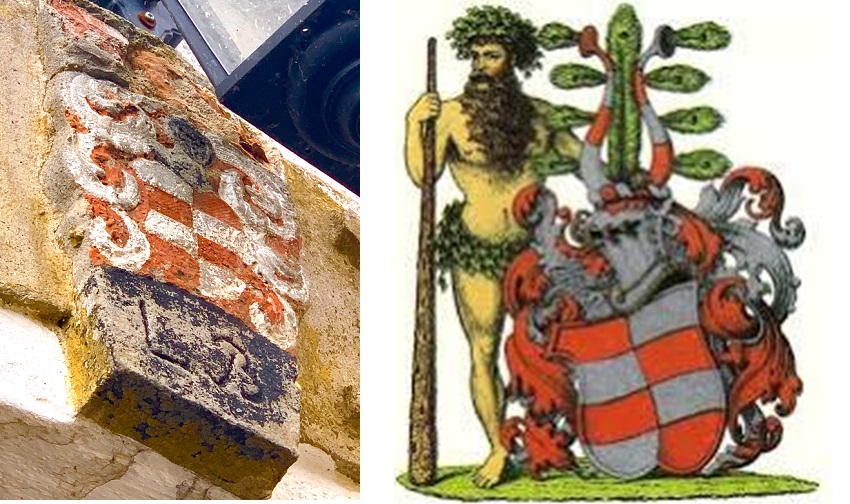
- Dexter (Husband — Bille): Parted per pale and tierced per fess counterchanged gules and argent (a checkered shield of eight panes). Crest: two buffalo horns parted per pale argent and gules. Supporter: a savage (vildmand) holding a club. Mantling: gules doubled argent (Hiort-Lorenzen & Thiset, 1890).
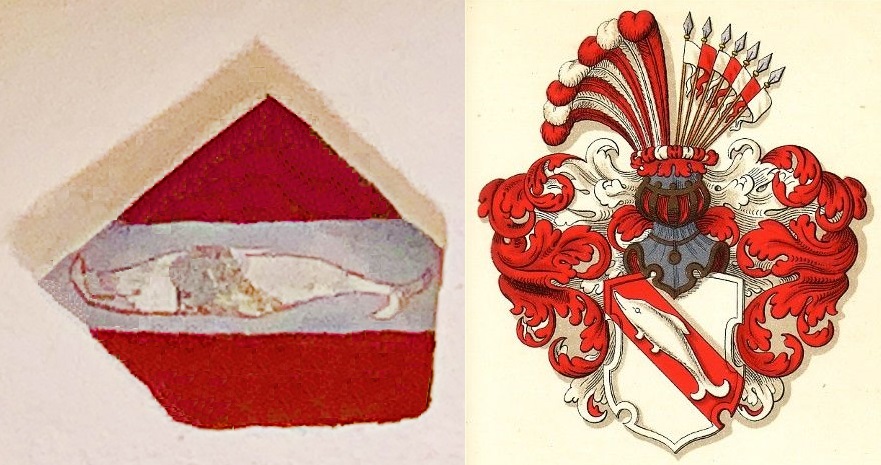
- Sinister (Wife — Marsvin): Gules, a bend argent (tarnished) charged with a porpoise (marsvin). Crest: four curved ostrich plumes alternating gules and argent on the dexter side, and four thin staffs fanning outward on the sinister side, each topped with a small gules-and-argent tournament pennant (departing from the canonical seven-plume blazon). Mantling: Or doubled azure (Hiort-Lorenzen & Thiset, 1904).
- Genealogical Note: While Pernille Marsvin and Lave Bille (1607–1679) linked the two dynasties at Dybäck, the initials H. J. B. point to a collateral or subsequent male relative rather than Lave Bille himself.
4. Lower Right Panel (F. R. B. F. O. M. W. — Beck & von Rohr)
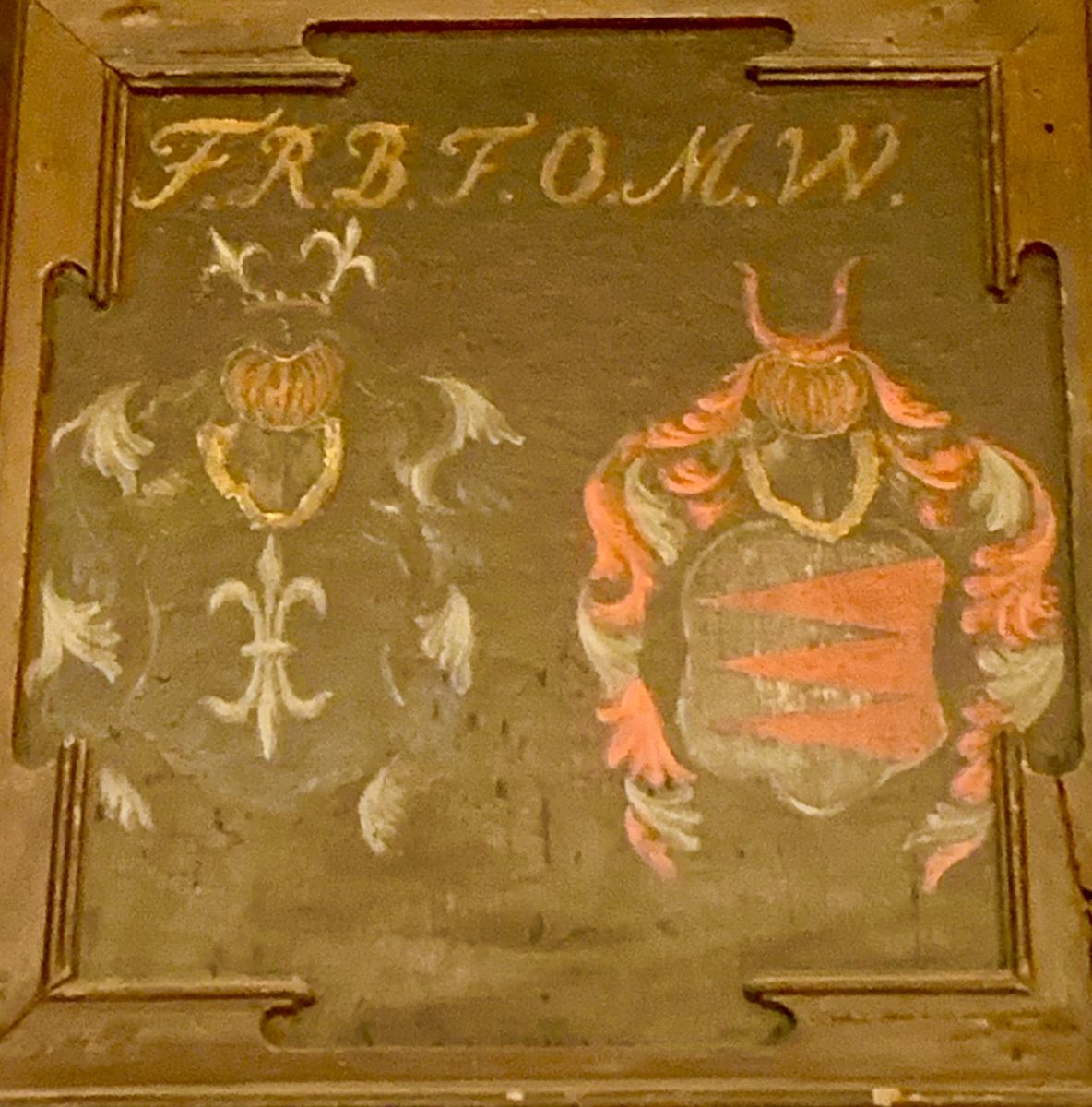
- Dexter (Husband — Beck): Azure, a double lily (Doppellilie) argent. Crest: a crowned helm bearing the same double lily argent between two buffalo horns. Mantling: azure doubled argent (Danmarks Adels Aarbog, 1951; Holbek, 2023). Geographically and genealogically, this Scanian branch of the ancient Beck family held neighboring estates in Vemmenhögs härad—such as Näsbyholm (10 km from Dybäck), Taagerød, Gladsaxe, and Andrarum—and acquired Börringekloster in 1723. Crucially, the depiction of the simple, undivided lily shield proves that the cabinet was painted prior to 1733–1770, when the lineage inherited the Friisenborg fideikommis, adopted the name Beck-Friis, and received baronial (1770) and comital (1771/1791) titles with a far more complex quartered coat of arms (Svenskt biografiskt lexikon, 1922; Riddarhuset, 2026).
- Sinister (Wife — von Rohr): Visually, a black-and-red shield parted per pale indented (im Spitzenschnitt gespalten), with three dark grey-black points on the dexter side directed toward the sinister interlocking with three gules points on the sinister side. Crest: two buffalo horns gules (Büffelhörner). Mantling: gules and dark grey-silver. One must hypothesize, however, that the dark grey-black pigment on the dexter indentations and the inner folds of the mantling is not black enamel (Schwarz), but oxidized silver (Silber)—as silver leaf and silver pigment on 16th–18th-century wooden panels naturally tarnish under varnish and atmospheric sulfur (Kasyanenko, 2026). Accounting for oxidized silver, this matches the classical arms of the noble house von Rohr, whose older Northern European and Scandinavian branches retained the two red buffalo horns (prior to the later adoption of a fox between roses in younger lines) and integrated into Swedish (Von Rohr nr 807, 1672) and Danish nobility (Siebmacher, 1857; Elgenstierna, 1931; Thiset & Wittrup, 1904).
- Epigraphic Note: Both seven-letter inscriptions differ only in their first two characters (H. J. vs. F. R.) while sharing the identical five-letter sequence B. F. O. M. W., pointing to a shared titular or estate formula rather than a surname; without documentary proof, any internal segmentation remains open (Kasyanenko, 2026).
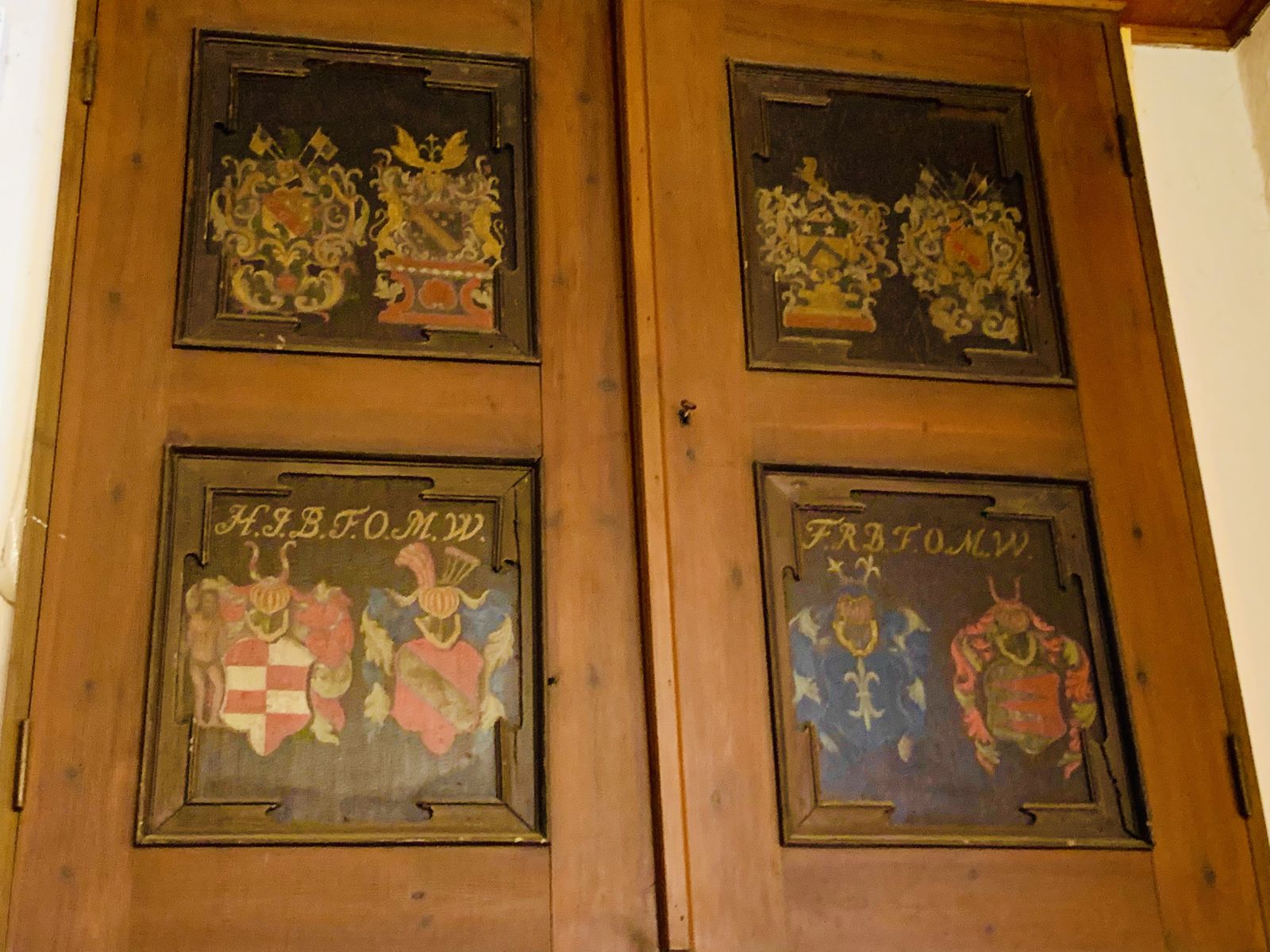
Generational Structure and the Status Counterargument: In classical Ahnentafel logic, the inscribed lower row typically fixes the foundational generation (parents or grandparents), while the uninscribed upper row represents the preceding generation (great-grandparents)—meaning that the Ahnenverlust (repetition of the horseshoe-and-unicorn arms) occurred among the earlier ancestors. However, a compelling status counterargument emerges from the visual hierarchy of the panels: the upper coats of arms are executed with markedly greater ceremonial grandeur—both the upper left sinister shield (with outward-turned lion supporters) and the upper right dexter shield rest upon carved Baroque architectural pedestals (socles), whereas the inscribed lower pairs lack pedestals altogether. This permits two competing hypotheses: either the commissioner descended along the maternal line from an older titled house (placed in the upper ancestral tier), or the upper register represents a later generation of descendants who had already attained higher noble rank, while the lower register records their untitled predecessors.
Exterior Architectural Heraldry & Restoration Inversions
Four exterior artifacts at Dybäck further contrast with the cabinet’s authentic polychromy:
1. Tower Niche Relief (Marsvin Arms): Displays an inverted color scheme—a gules field crossed by a silver fess bearing a porpoise of the same tincture—where a later restoration swapped metal and tincture and altered the bend into a fess.
2. Entrance Cartouche (L. B. — Lave Bille): Carved stone shield above the main portal with inverted tinctures (gules on the dexter, argent with two fesses gules on the sinister), confirming a simultaneous 19th- or 20th-century repainting without heraldic supervision.
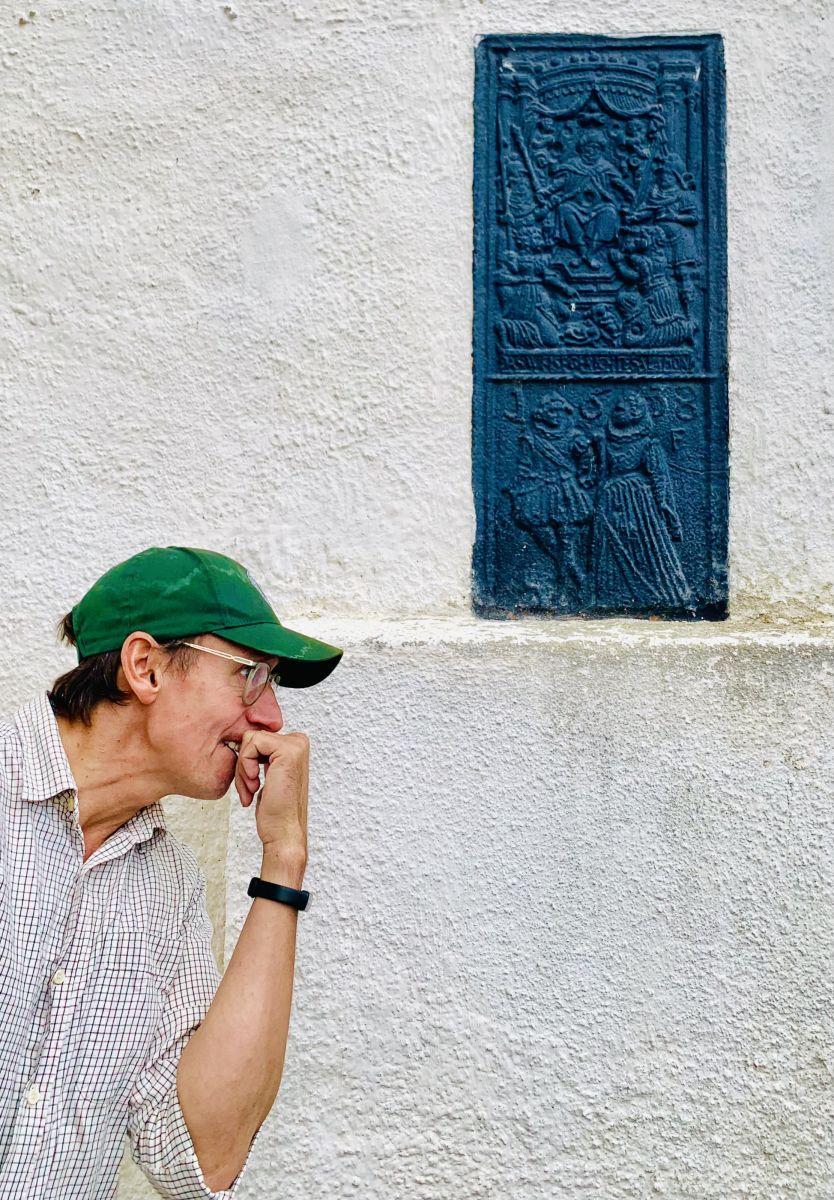
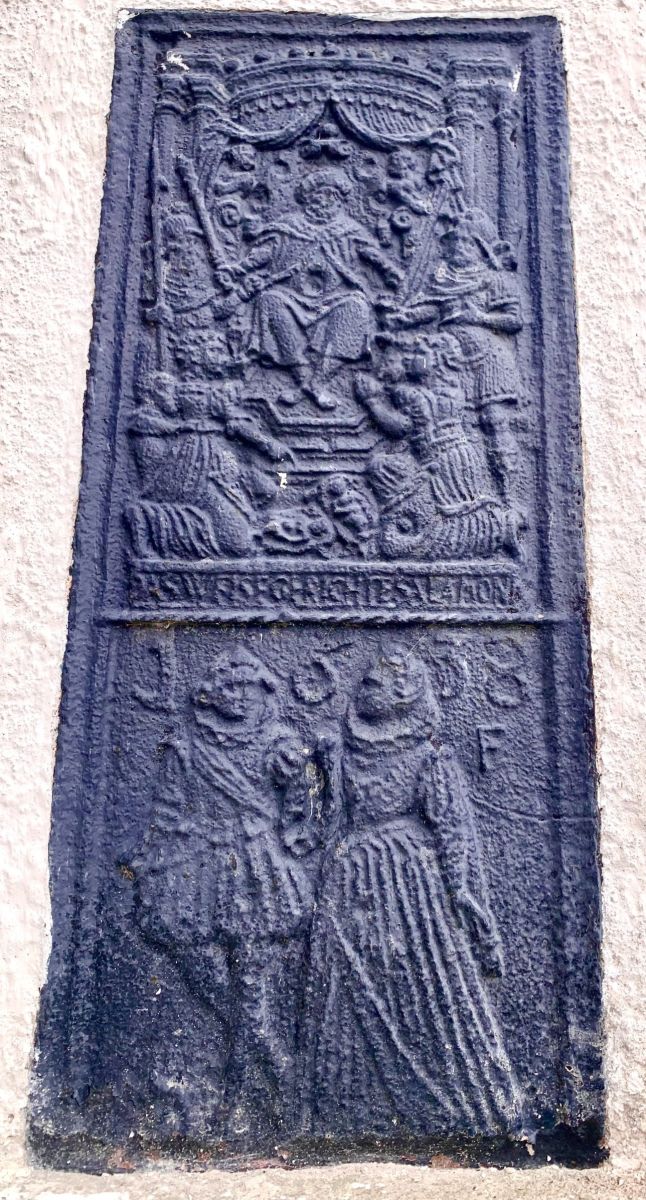
4. 1638 Cast-Iron Stove Plate: Embedded in an exterior wall, bearing the date 1638, a biblical judgment scene, and a noble couple in 1630s attire (with foundry mark F) from Otte Marsvin’s era.
4. 19th-Century Door Tympanum (Mercantile-Industrial Emblem of the Wallis Family): Above a secondary doorway, a semicircular Neoclassical wooden tympanum displays a composite bourgeois emblem: an anchor overlaid with a pickaxe and two intertwined serpents reminiscent of Mercury’s caduceus (Kasyanenko, 2026).
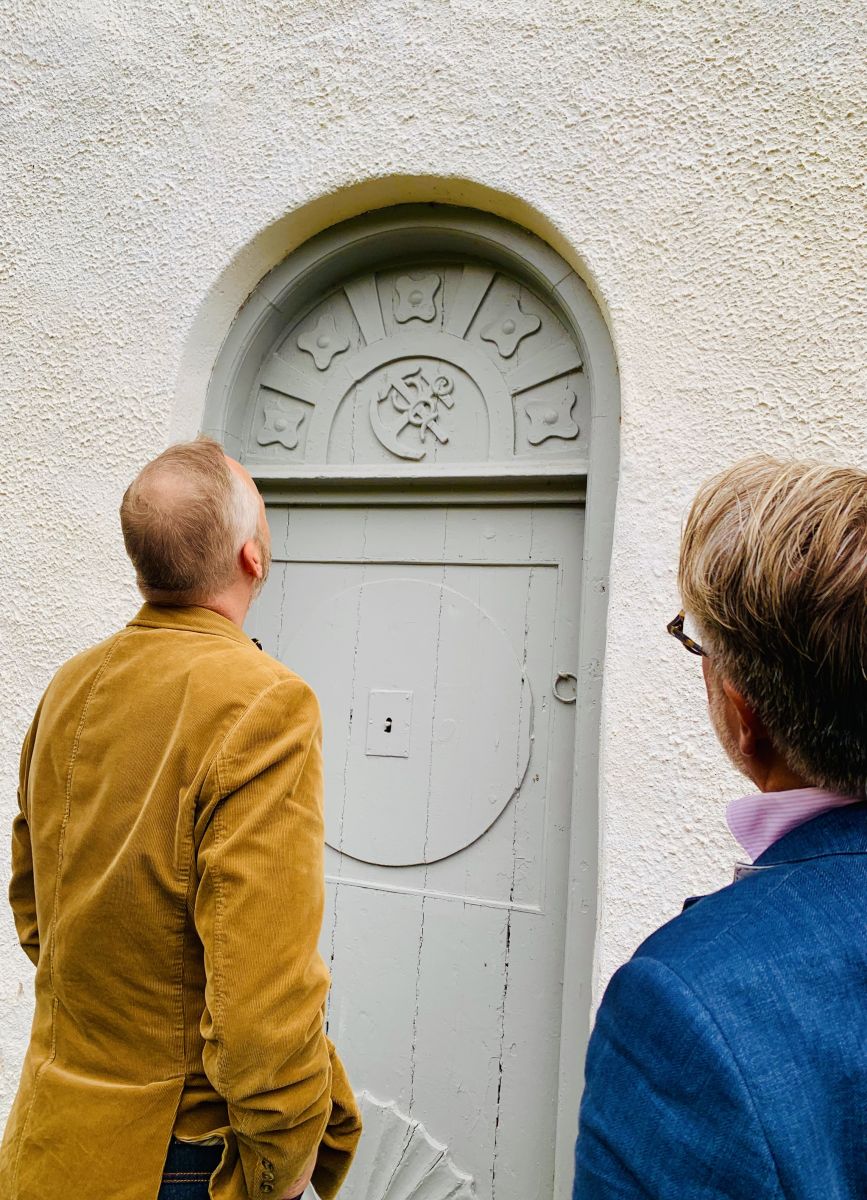
Far from being a conventional monogram, this iconography directly reflects the rise of the new commercial and industrial bourgeoisie that succeeded the old aristocratic dynasties (Marsvin, Bille, Sparre, Gyllenkrok) at Dybäck during the Industrial Revolution (Åberg, 1966; Haben, 2025). In 1822, the eastern half of the estate (Krokeparten) was purchased by the wholesale merchant (grosshandlare) Albrecht Baltzar Wallis the Elder (1788–1836); in 1857, his son, Albrecht Baltzar Wallis the Younger (1815–1889), acquired the remaining half (Sparreparten), reuniting the castle after 173 years of divided ownership and keeping it in the family until 1921 (Åberg, 1966).
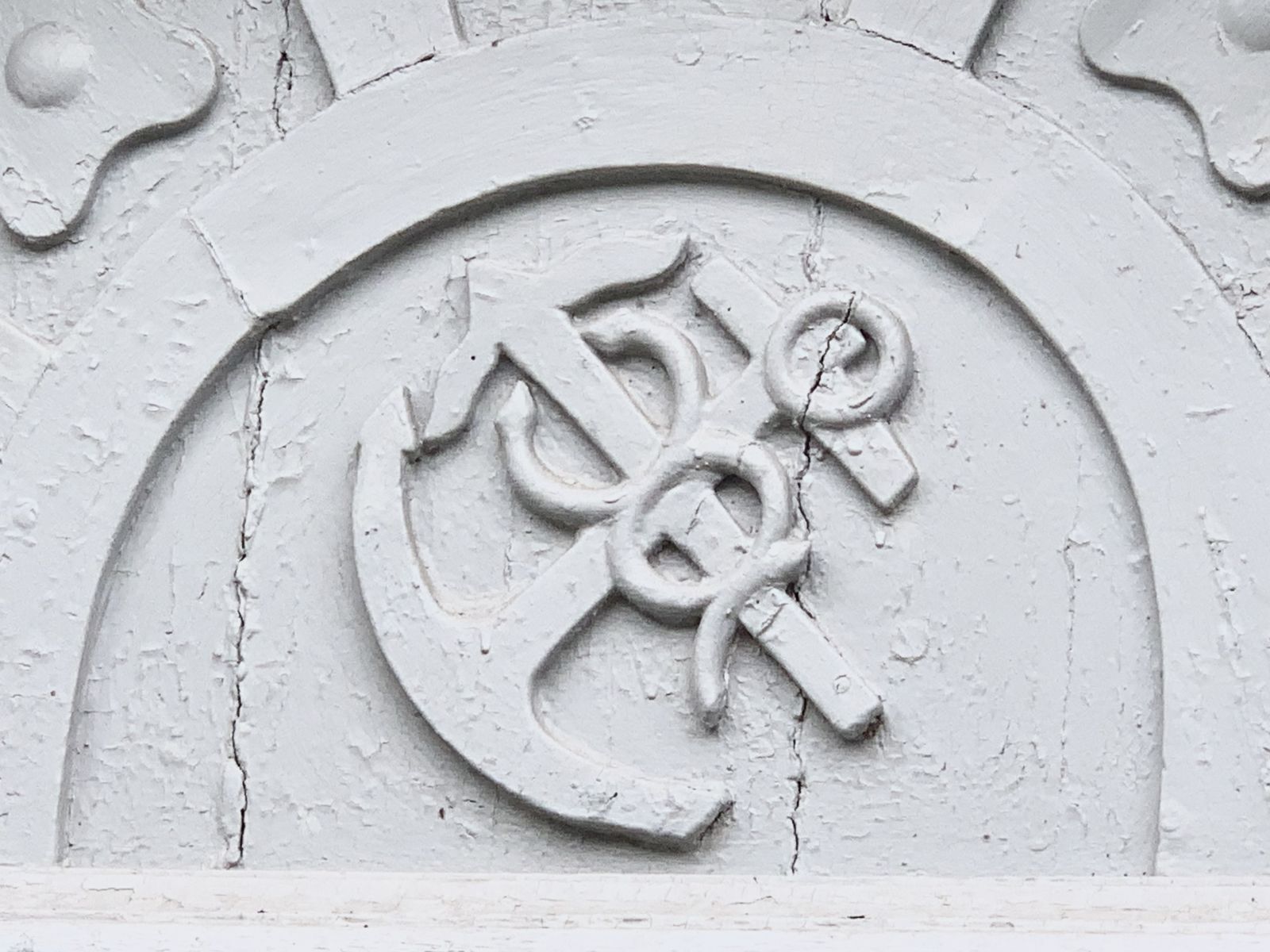
Originating from Pomerania and established in Stockholm and Skåne, the Wallis family built its fortune on maritime shipping (rederi) and early industrialization, which explains every element of the tympanum’s composition: along the coast of Skåne—where the southern port of Smygehuk lies just a couple of kilometers from Dybäck, with Ystad nearby—the Wallis family actively engaged in maritime trade, grain exports, and shipping (symbolized by the anchor), whereas the pickaxe and Mercury’s serpents denote commerce alongside the extraction and processing of raw materials—specifically the major limestone and chalk quarries and kilns operating along the Smygehuk coast, as well as sugar refineries, distilleries, and the comprehensive industrial modernization of the Dybäck estate carried out by Wallis the Younger (Haben, 2025).
L. B.) stone reliefs, to the 19th-century mercantile-industrial emblem (anchor, pickaxe, and Mercury’s serpents) reflecting the Wallis family’s maritime and industrial capital.- The Vemmenhögs Härad Manorial Nexus (Dybäck and Näsbyholm):
All four dynasties were deeply rooted within the same micro-region of southern Scania—specifically along the axis connecting Dybäck Castle (Östra Vemmenhög parish) and the neighboring estate of Näsbyholm (located roughly 10 km away in the same hundred of Vemmenhögs härad). During the 17th century, the Bille and Marsvin families held both Dybäck and Näsbyholm, while the Beck and von Rohr lineages controlled Näsbyholm and adjacent manors into the early 18th century (notably Göran Beck, proprietor of Näsbyholm in 1729–1734, who married into the von Rohr family). When the Ingelotz family acquired the western moiety of Dybäck (Sparreparten) in 1725 through Provincial Chamberlain Jacob Klerck, they entered an established aristocratic landscape where the heraldic emblems of Bille, Marsvin, Beck, and von Rohr already defined local manorial authority and parish church memorials. - Two Competing Models for the Cabinet’s Creation and Heraldic Program:
a) Model A — A Synchronized Chronicle of Proprietors (Herrschaftsprogramm / Symbolic Legitimation):
Both Christoffer Ehrensparre (ennobled in 1719, no. 1694) and Berndt Simon Ingelotz (ennobled in 1720, no. 1721) belonged to the newly elevated Swedish military nobility of the late Great Northern War. Upon acquiring Dybäck in 1725 and celebrating the marriage of Christina Gustaviana Ingelotz and Christoffer Ehrensparre at the castle on January 8, 1740, the new Swedish proprietors faced a classic challenge of early modern noble representation: visually anchoring a young, recently ennobled lineage within an ancient estate built by old Danish high aristocracy (uradel). By placing the 17th-century Danish–Scanian magnates (Bille & Marsvin; Beck & von Rohr) in the lower tier and crowning the cabinet with their own marital alliances of 1721 and 1740—complete with carved Baroque architectural socles and lion supporters—the commissioners constructed a visual narrative of uninterrupted lordship (continuatio dominii).
b) Model B — Material Adaptation and Secondary Overpainting (Heraldic Palimpsest):
Close visual and epigraphic inspection points equally to a physical two-stage history of the object. The lower panels feature gilded calligraphic initials (H. J. B. F. O. M. W.andF. R. B. F. O. M. W.) and a flatter, late-17th-century cartouche aesthetic, whereas the upper panels lack inscriptions altogether and display markedly more theatrical, mid-18th-century Baroque pedestals and supporters. This stylistic discrepancy suggests that an existing late-17th-century oak cabinet (originally commissioned around 1680–1700 within the Bille–Beck circle) was preserved in the castle and adapted around 1740 for the Ehrensparre–Ingelotz wedding: the upper doors were newly painted (or overpainted) with the arms of the bride’s parents and the newlyweds, while the inscribed lower panels were retained intact as a tribute to the estate's former lords (Kasyanenko, 2026).
While the core identities of all eight coats of arms on the cabinet are now established, resolving the remaining epigraphic and material questions defines a clear agenda for future scholarship:
- Archival Corroboration of the Beck–von Rohr Connection and the Formula
B. F. O. M. W.: Subsequent researchers should seek parish, manorial, and chancery records in Skåne and Denmark to pinpoint the exact individuals behind the initialsH. J. B.andF. R. B., document the marital union between the Scanian Beck and von Rohr families, and definitively expand the shared five-letter epigraphic formulaB. F. O. M. W.. - Sphragistic and Stratigraphic Verification: Further archival work in Helsingborg and Swedish Pomerania (to verify contemporary burgher seals of Mayor Bengt Lang’s lineage), alongside non-invasive dendrochronological and pigment analysis of the cabinet’s oak carcass, will definitively confirm whether the 1740 program was executed ab initio or as an overpainted palimpsest.
References
- Åberg, A. (1966). Kungaslott och adelsborgar i Skåne [Royal Castles and Noble Manors in Skåne]. Stockholm: Natur och Kultur.
- Armigers Report (2026). AI vs. Heraldic Artists: What else was discussed at the celebrations marking the 50th anniversary of the Swedish Heraldic Society. Varta Bavarii, 11 September 2026 [Online]. Available at: varta.com.ua [Accessed 21 November 2026].
- Danmarks Adels Aarbog (1951). Beck [Yearbook of the Danish Nobility]. Kjøbenhavn: J. H. Schultz Forlag..
- Elgenstierna, G. (1926). Den introducerade svenska adelns ättartavlor, Vol. II (Chapman–Fägerstråle). Stockholm: P. A. Norstedt & Söners Förlag. (Entry: Ehrensparre, nr 1694, p. 466). Available at: Adelsvapen-Wiki
- Elgenstierna, G. (1927). Den introducerade svenska adelns ättartavlor, Vol. III (Gadde–Höökenberg). Stockholm: P. A. Norstedt & Söners Förlag. (Entry: Gyllenpamp, nr 675, p. 317). Available at: Project Runeberg
- Elgenstierna, G. (1928). Den introducerade svenska adelns ättartavlor, Vol. IV (Igelström–Lillietopp). Stockholm: P. A. Norstedt & Söners Förlag. (Entries: Ingelotz, nr 1721, p. 11; Langenhielm, nr 1294, p. 502). Available at: Adelsvapen-Wiki (Ingelotz) & Adelsvapen-Wiki (Langenhielm)
- Elgenstierna, G. (1931). Den introducerade svenska adelns ättartavlor [Genealogical Tables of the Introduced Swedish Nobility]. Vol. 6 (von Rohr nr 807). Stockholm: P. A. Norstedt & Söners Förlag.
- Elgenstierna, G. (1932). Den introducerade svenska adelns ättartavlor, Vol. VII (Norberg–Stålarm). Stockholm: P. A. Norstedt & Söners Förlag. (Entries: Silnecker, nr 988, p. 226; Stobée, nr 1439, p. 689). Available at: Adelsvapen-Wiki (Silnecker) & Adelsvapen-Wiki (Stobée)
- Haben, B. (2025). Parken och trädgårdarna vid Dybäcks slott: Historisk översikt och vårdplan [The Park and Gardens at Dybäck Castle: Historical Overview and Management Plan]. Alnarp: Sveriges lantbruksuniversitet (SLU). Available at: slu.se [Accessed 21 November 2026].
- Hiort-Lorenzen, H. R. & Thiset, A. (1890). Danmarks Adels Aarbog [Yearbook of the Danish Nobility]. Vol. 7 (Bille). Kjøbenhavn: Vilhelm Trydes Boghandel.
- Hiort-Lorenzen, H. R. & Thiset, A. (1904). Danmarks Adels Aarbog [Yearbook of the Danish Nobility]. Vol. 21 (Marsvin). Kjøbenhavn: Vilhelm Trydes Boghandel.
- Historiskt-geografiskt och statistiskt lexikon öfver Sverige (1860). Vol. II (C–F). Stockholm: Åke C. W. Hammars Förlag. (Entry: Dybäck, p. 147). Available at: Project Runeberg
- Holbek, F. (2023). Beck – våbenskjold (Danmarks Adels Aarbog 1951), Skeel, Schaffalitzky og Ahlefeldt Genealogy Database [Online]. Available at: finnholbek.dk [Accessed 21 November 2026].
- Kasyanenko, R. (2026). Field documentation and photographic survey of the interior and exterior heraldic complex of Dybäcks slott during the joint excursion of Societas Heraldica Lundensis and Svenska Heraldiska Föreningen, 6 September 2026. Unpublished field notes.
- Riddarhuset (2026). Beck-Friis (Friherrliga ätten nr 278 / Grevliga ätten nr 104), Minerva – Riddarhusets ätte- och vapendatabas [Online]. Available at: riddarhuset.se [Accessed 21 November 2026].
- Riksarkivet / Europeana Heraldica (n.d.). Adliga ätten Ingelotz nr 1721 (Record ID 9029). National Archives of Finland & Sweden. Available at: Europeana Heraldica
- Rosborn, S. (1984). Skånska slott och herresäten [Scanian Castles and Manor Houses]. Malmö: Corona.
- Siebmacher, J. (1857). J. Siebmacher's grosses und allgemeines Wappenbuch: Der Adel des Königreichs Preußen und der Herzogthümer Mecklenburg [J. Siebmacher's Great and General Armorial: The Nobility of Prussia and the Duchies of Mecklenburg]. Nürnberg: Bauer & Raspe.
- Slottsguiden (2021). Dybäck, Sverige [Online]. Available at: slottsguiden.info [Accessed 21 November 2026].
- Svenska Heraldiska Föreningen (2026). Utflykt till Dybäck slott (Societas Heraldica Lundensis & Svenska Heraldiska Föreningen), 6 September 2026 [Online]. Available at: https://heraldik.se/event/utflykt-till-dyback-slott/ [Accessed 21 November 2026]
- Svenskt biografiskt lexikon (1922). Beck-Friis, släkt, Vol. 3, p. 1 [Online]. Available at: riksarkivet.se [Accessed 21 November 2026].
- Thiset, A. & Wittrup, P. L. (1904). Nyt dansk Adelslexikon: Fortegnelse over dansk Adel i Fortid og Nutid [New Danish Nobility Lexicon: Register of Danish Nobility in Past and Present]. Kjøbenhavn: Vilhelm Trydes Boghandel.