Burning Kyiv’s bridges or breaking its spine? The prospects of a "Russian winter" for Ukraine

Opening the briefing, Simon Schlegel, Ukraine Program Director at LibMod, framed the discussion around whether the latest escalation represents a tactical bottlenecking of the city’s logistics or a deliberate effort to compromise Kyiv’s core operational capacity ahead of a Moscow-engineered energy offensive.
.jpg)
In response, experts from Kyiv School of Economics (KSE) presented an analysis of the infrastructure offensive, starting with the targeted isolation of the Left Bank.
“The rationale behind Russian strikes on Kyiv's bridges — including the North Bridge, which was hit precisely during German Chancellor Friedrich Merz's visit to Kyiv — is to isolate the Left Bank, which is home to approximately 600,000 residents of the capital,” notes Alexandra Vacroux, vice-president KSE for strategic engagement. “However, a new threat has now emerged: the Russians may consider attempting to flood the Left Bank by destroying portions of the dams or riverbanks that prevent water from inundating its low-lying areas. While strikes on the water and sanitation supply would be significantly more critical for the Left Bank, they would nonetheless pose a massive challenge for Kyiv as a whole.”
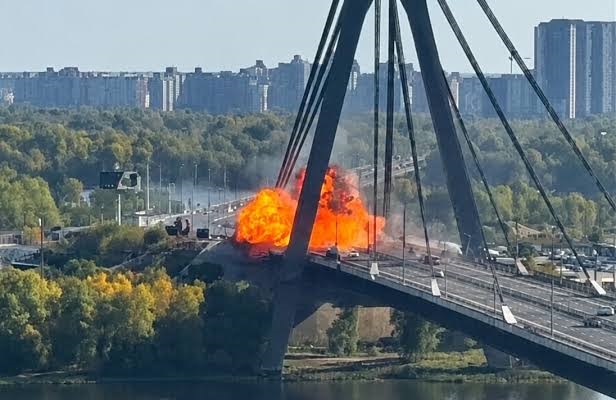
According to Vacroux, the primary source of this pressure is the mass deployment of new jet-powered Shahed drones. “A near-continuous presence of at least one UAV over Kyiv or its outskirts triggers frequent air raid alerts,” the analyst continues. “These drones feature real-time guidance systems, making them reactive and capable of mid-flight redirection; as a result, they bypass predictable straight-line trajectories, complicating strike-point forecasting.” Furthermore, because they fly significantly faster than the previous iteration of the Geran drones, Ukraine's existing mobile interception systems simply cannot match their speed to engage them successfully, Vacroux emphasizes.


“The core vulnerability remains Ukraine's severely depleted air defense architecture,” Vacroux notes, pointing to a critical exhaustion of Patriot interceptor stockpiles nationwide. “Ukrainian crews have had to fundamentally adapt their interception doctrine, rationing resources to fire a single Patriot interceptor per incoming ballistic missile — down from the tactically recommended standard of two. This supply crunch is further exacerbated by geopolitical dynamics: intense air defense engagements in the Middle East have severely strained global interceptor inventories. Consequently, Kyiv has been forced into significant tactical shifts, increasingly deploying F-16 fighter jets to engage both jet-powered Shahed drones and low-altitude ballistic threats.”
.jpg)
Her colleague, an associate security analyst at the Sahaidachnyi Security Center and KSE Head of National Security and Defense Programs Yevhenii Malik, smoothly shifts the conversation toward the immediate needs of the Ukrainian army on the front line. “The Ukrainian army — taking into account all of its units — is producing about 20,000 UGVs right now,” Yevhen notes. “The most ambitious plan for the Ukrainian army is to achieve 100,000 UGVs next year. But that is just 20% of our total needs! And what is most important, that might even not be enough.”
The expert provides the pragmatic economics of warfare: the average price of a UGV is $15,000. The cost of a weapon, if it is a combat UGV (such as a Browning machine gun, an MK19 grenade launcher, etc.), adds an extra $5,000. An additional $5,000 is required if the platform features an AI modification, as the Armed Forces of Ukraine already deploy such variants. “Altogether, it comes to about $25,000. Meanwhile, if you lose an infantry soldier on the battlefield, you have to pay at least $100,000 to his family. Robotic platforms can substitute infantry on the battlefield. Yes, not 100%, but somewhere around 50 to 60% — and that is unbelievably a lot. If we are speaking, for instance, about a hypothetical 100,000 infantrymen on the frontline, and we substitute 60,000 of them with robots, those people will stay alive. Isn't it great?”

Despite the accumulation of these systemic challenges in the fifth year of the full-scale war against a powerful aggressor, Ukrainians demonstrate an unprecedented level of resilience. This resource gap is hardly surprising given the scale of Ukraine's military expenditure, which currently consumes approximately 40% of its GDP.
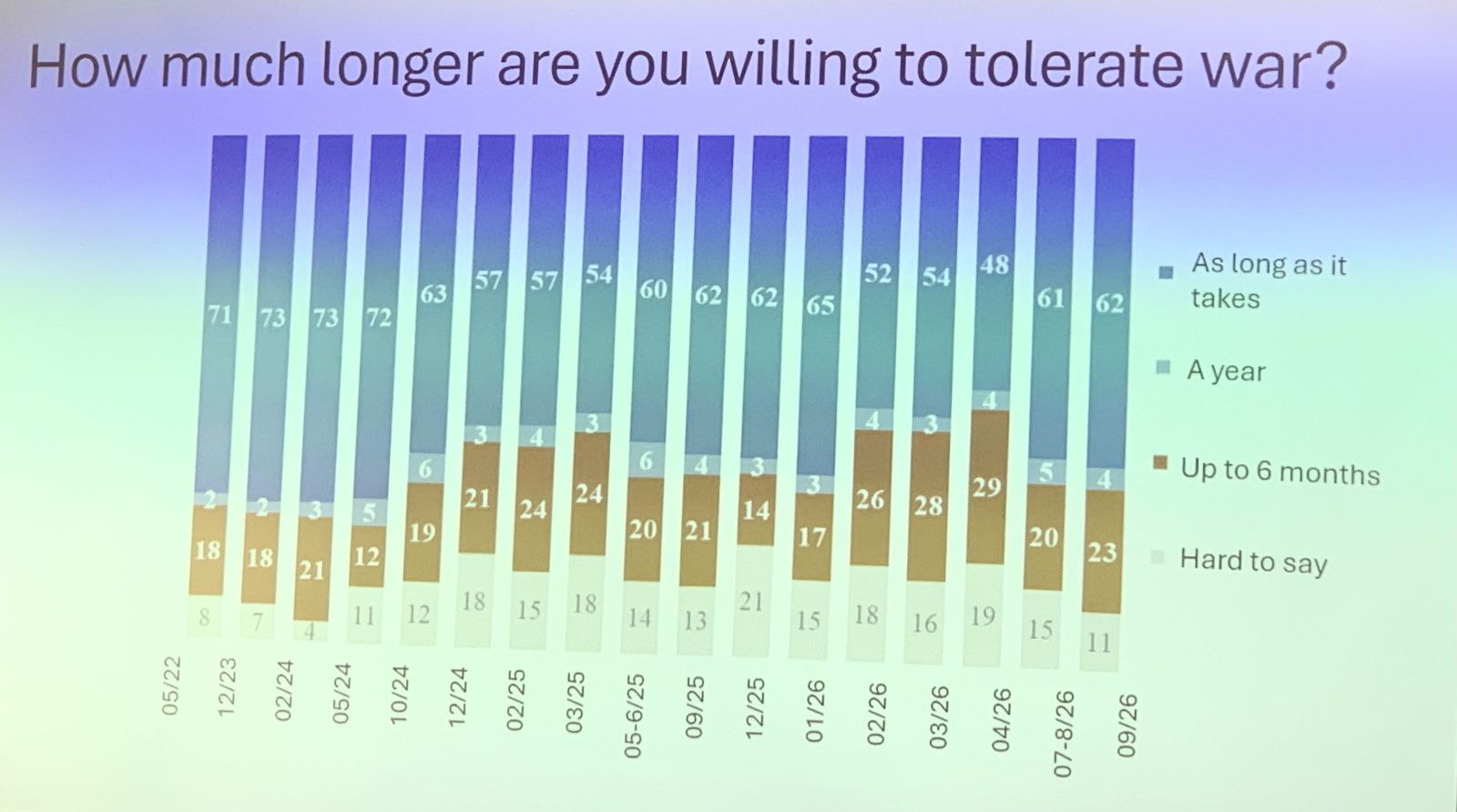
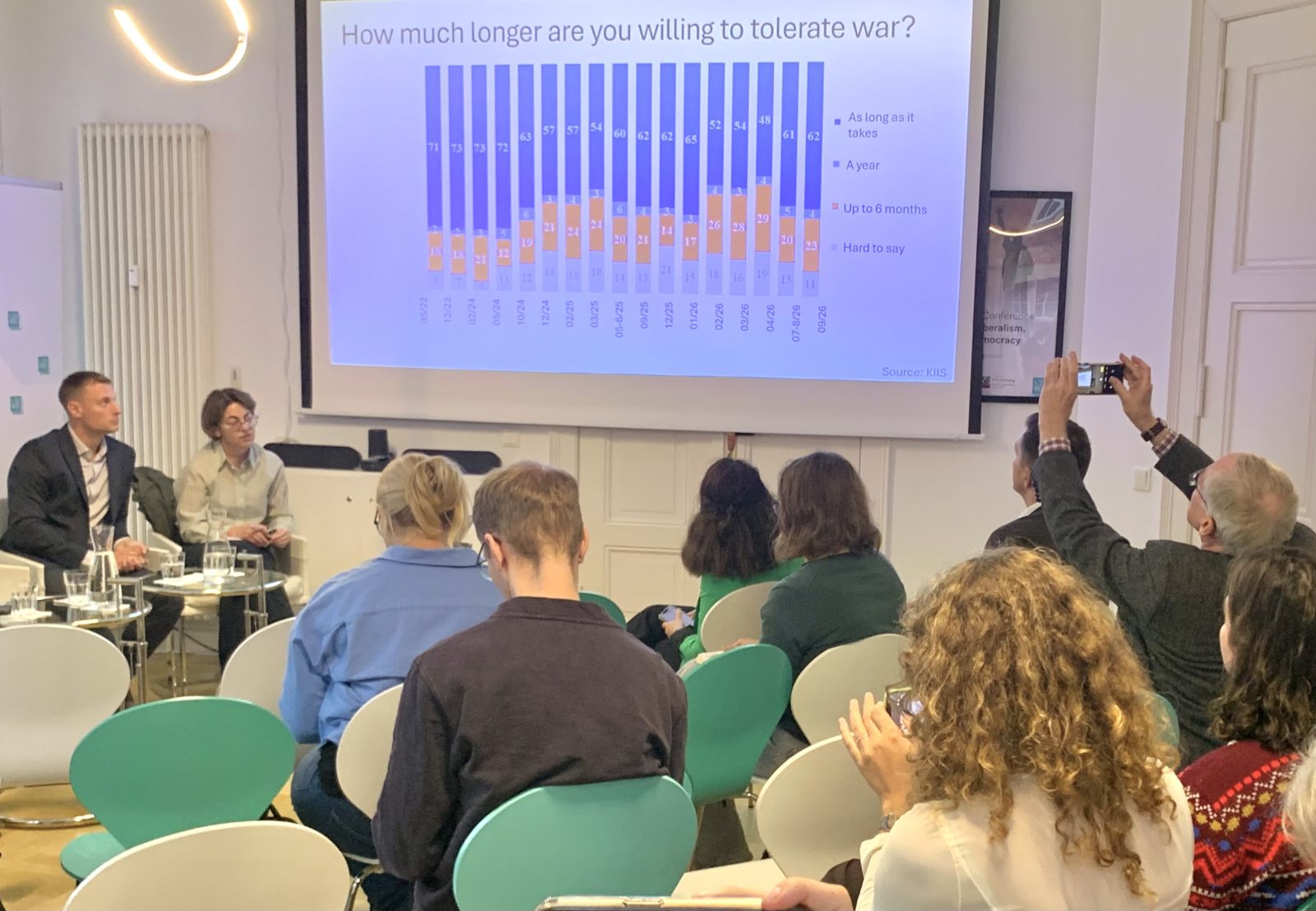
“To put this into perspective, while European nations face severe internal strain merely discussing an increase in defense spending to 3.5% or 5%, Ukraine has sustained a 40% allocation. This massive fiscal burden exerts profound pressure on the domestic economy and fundamentally alters daily life,” Vacroux emphasizes. “Remarkably, however, longitudinal sociological research spanning from May 2022 to September 2026 demonstrates that public resilience remains steadfast. The vast majority of the population consistently maintains that the defense must continue for as long as it takes, with fewer than 25% of citizens favoring a cessation of hostilities on terms that imply capitulation or ceding territory to Russia”.
About speakers
Alexandra Vacroux is vice-president for strategic engagement at the Kyiv School of Economics. She previously served as executive director of Harvard University’s Davis Center. Her scientific background is in research on the political economy of Russia, underpinned by on-the-ground experience in the finance sector.
Yevhenii Malik is a former Marine Infantry sergeant in the Armed Forces of Ukraine and a veteran of the Russia-Ukraine War, a defender of Mariupol. He is an associate security analyst at the Sahaidachnyi Security Center and Head of National Security and Defense Programs at the Kyiv School of Economics.