Porpoise vs. Unicorn: Heraldic Attribution of the Baroque Cabinet and Architectural Armorials at Dybäck Castle in Skåne
Located in Skurup Municipality (Dybäcks slott), the estate has long been studied through its recorded succession of owners (Åberg, 1966; Slottsguiden, 2021). However, the unpublished armorial complex preserved both inside and outside the castle—anchored by an oak cabinet—serves as primary heraldic evidence that revises these established narratives.
Provenance of the Study & Scientific Novelty
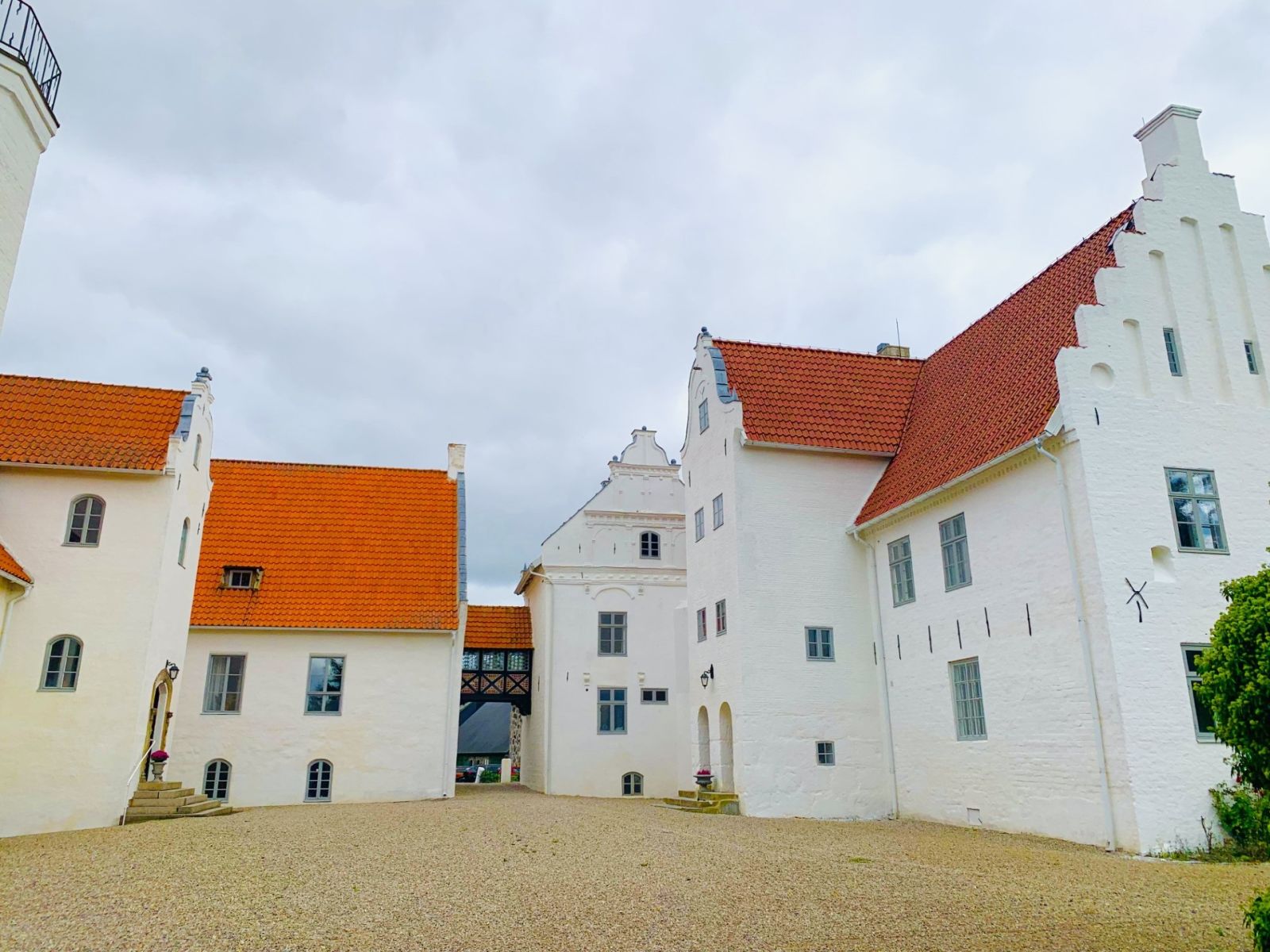
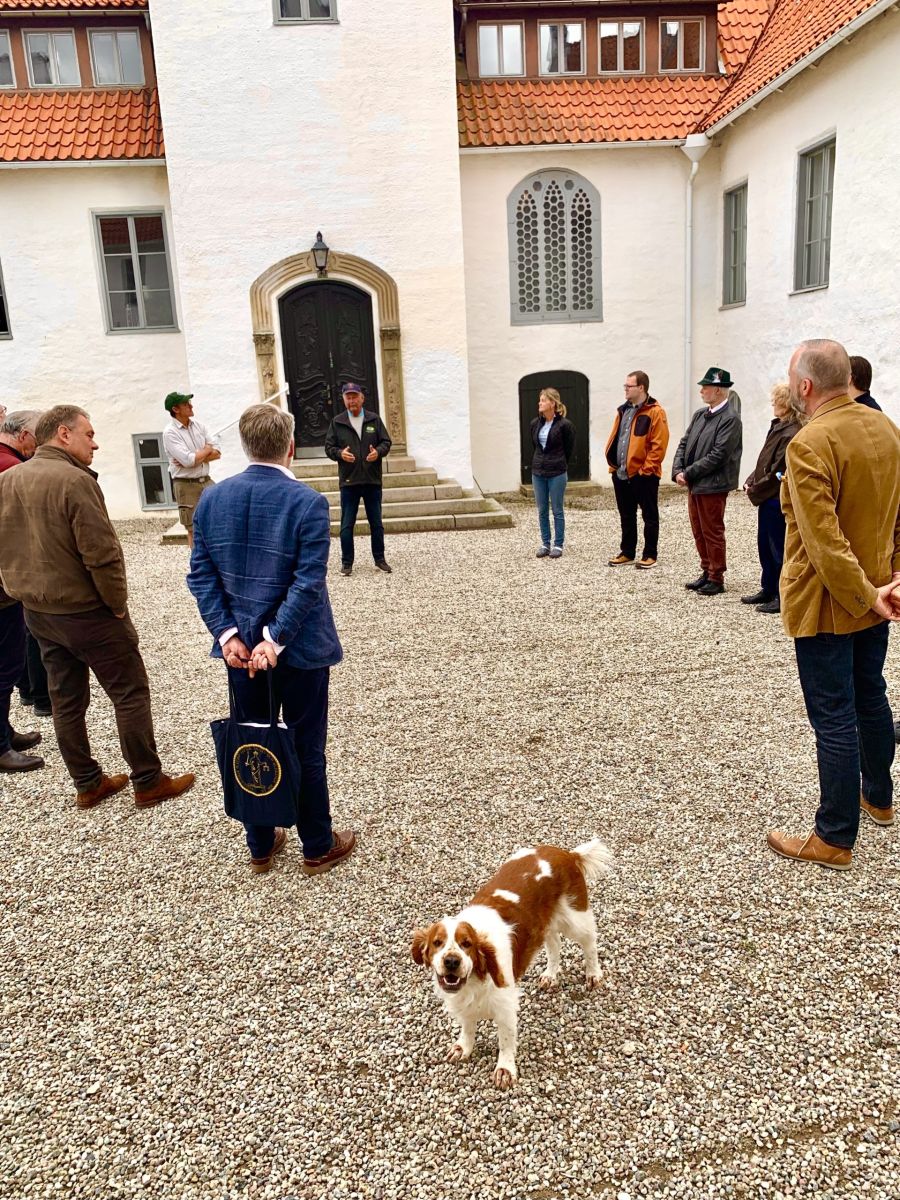
Because Dybäck Castle remains a private residence of the Alwén family—currently stewarded by Carl-Otto and Magnus Alwén—its interior artifacts have largely escaped academic cataloging (Haben, 2025). This study presents first-hand field documentation recorded by the author during the joint excursion of Svenska Heraldiska Föreningen and Societas Heraldica Lundensis (Utflykt till Dybäck slott) on September 6, 2026 (Armigers Report, 2026)
The Cabinet’s Heraldic Program vs. Recorded Owners of Dybäck
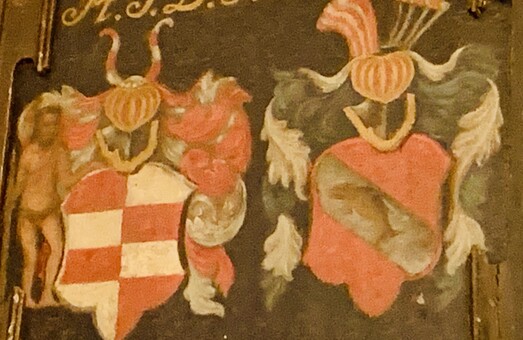
A critical comparison between the documented owners of Dybäck and the four pairs of alliance coats of arms on the Baroque oak cabinet reveals a striking discrepancy: the medieval Bing (red tower on silver) and Hollunger (three mill wheels) families, as well as the Brahe family (silver pale on black, introduced via Otte Marsvin’s 1604 marriage to Mette Pedersdatter Brahe), are completely absent from the furniture (Thiset & Wittrup, 1904). Instead, the cabinet constitutes a Scandinavian Ahnentafel (ancestral table) displaying four pairs of paternal and maternal ancestors across generations. Following canonical heraldic convention, the panels are blazoned below from top to bottom and left to right (from the viewer's perspective), although it is specifically the inscribed lower panels that serve as the primary chronological and genealogical key to attributing the entire cabinet:
1. Upper Left Panel (Uninscribed — Horseshoe-and-Unicorn Arms & Titled Star-and-Bend Arms)
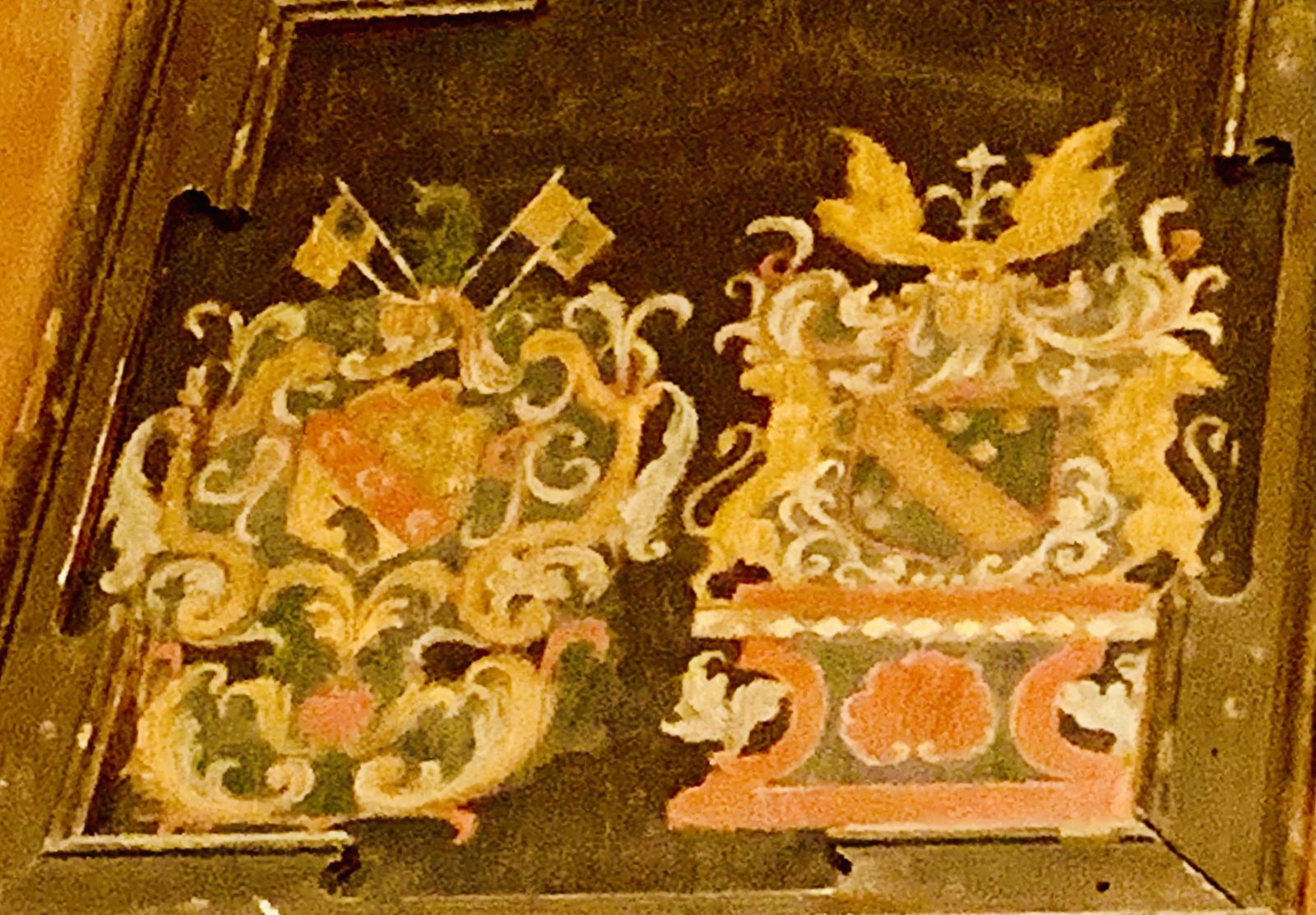
- Dexter (Husband — Horseshoes & Black Unicorn): Or, on a bend gules three horseshoes argent (a shield charge resembling the Swedish noble family Hästesko), with a black unicorn issuant in the lower field. Crest: a crowned helm from which a black unicorn with a golden horn issues between two pairs of (azure-and-gold) tournament flags. Mantling: argent doubled Or (Elgenstierna, 1926).
- Sinister (Wife — Bend, Six Stars & Outward-Turned Lion Supporters): Sable (or darkened azure), a bend Or accompanied by six six-pointed mullets (stars) argent (or Or), three above and three below arranged along the bend in a 2:1 order. Crest: a crowned helm bearing a silver heraldic lily on a stem between a pair of open golden eagle wings (offener Flug). Mantling: argent doubled Or. Supporters: flanking the cartouche stand two golden lions turned outward away from the shield (abgewendet). Pedestal: the coat of arms rests upon a carved Baroque socle with red-terracotta volutes, a golden molding band, and a stylized shell/palmette in the center—an explicit heraldic indicator of higher titled nobility (friherre or greve) within the Swedish–Danish sphere (Elgenstierna, 1926).
2. Upper Right Panel (Uninscribed — Chevron & Recurrence of the Horseshoe-and-Unicorn Arms / Ahnenverlust)
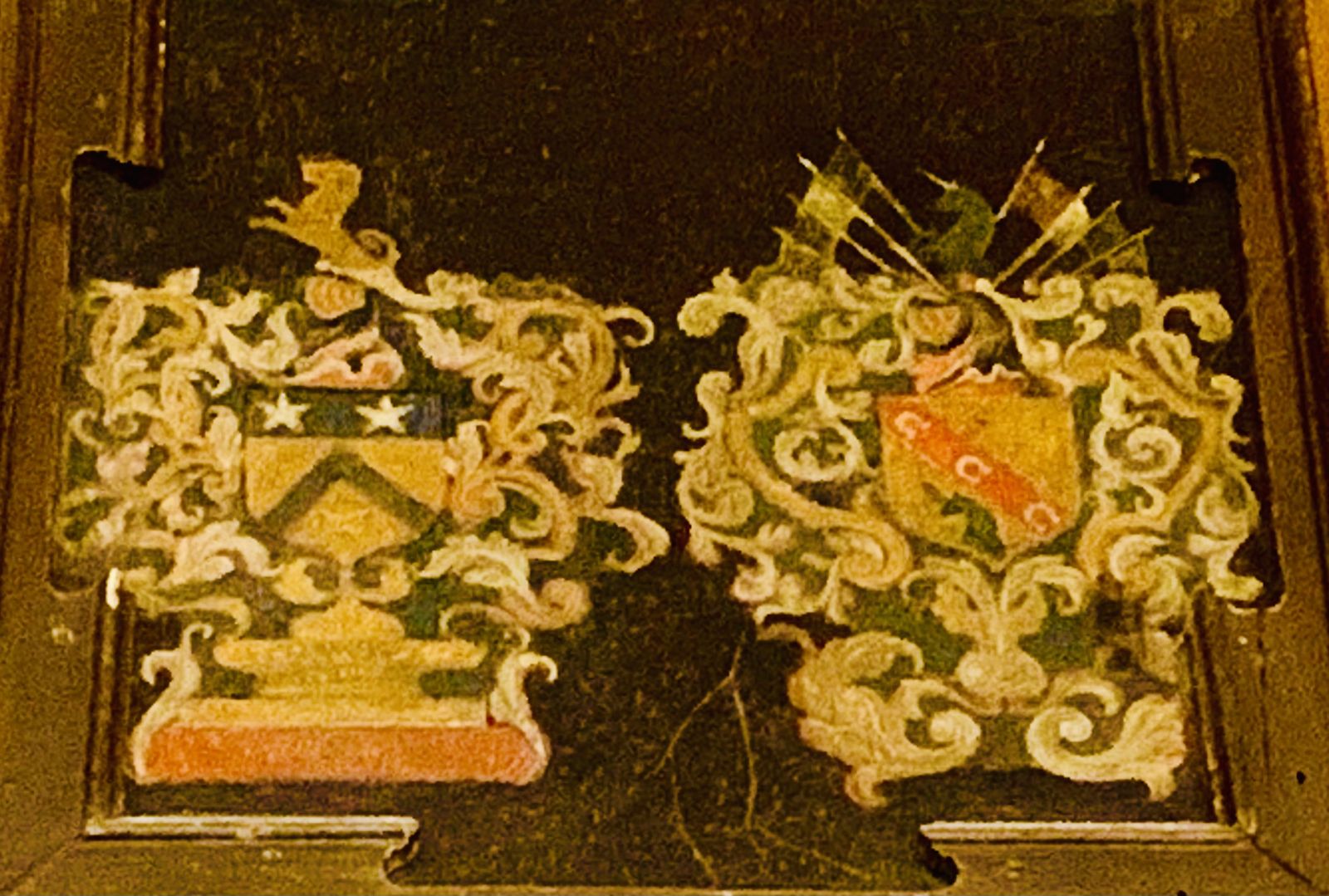
- Dexter (Husband): Or (tarnished argent), a chevron sable; on a chief sable two six-pointed mullets (stars) argent. Crest: a crowned helm with a golden lion issuant. Mantling: sable doubled Or/argent. Pedestal: the shield rests upon a carved Baroque architectural socle, serving as a visual marker of elevated rank.
- Sinister (Wife — Recurrence of the Horseshoe-and-Unicorn Arms): An exact repetition of the dexter coat of arms from the upper left panel—featuring the bend gules with three horseshoes argent, the black unicorn issuant in the lower field, and the black unicorn with a golden horn issuing between the tournament flags in the crest. This direct recurrence across paternal (upper left) and maternal (upper right) panels illustrates Ahnenverlust (pedigree collapse resulting from endogamous noble marriages); consequently, one may hypothesize that the commissioner of the cabinet most likely descended from this lineage on both sides of the family (Elgenstierna, 1926).
3. Lower Left Panel (H. J. B. F. O. M. W. — Bille & Marsvin)
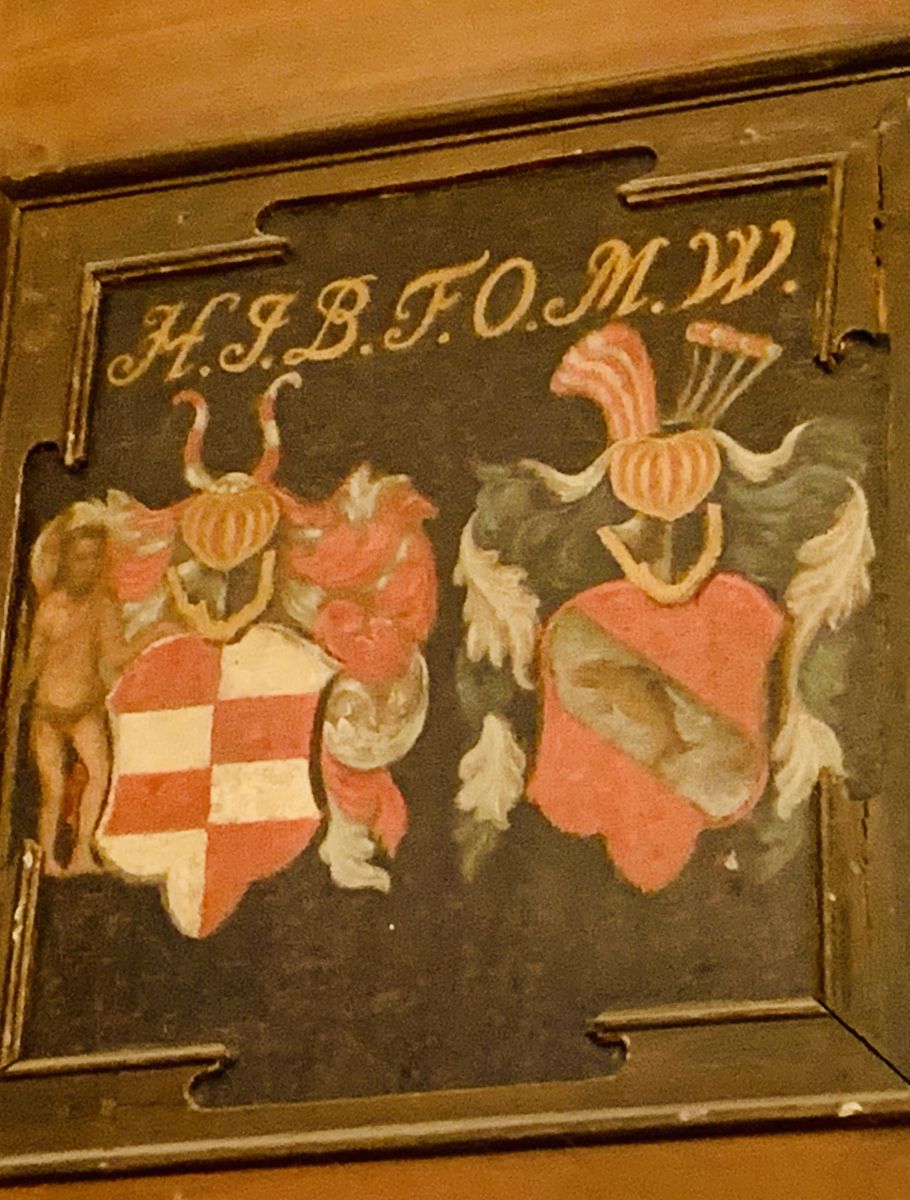
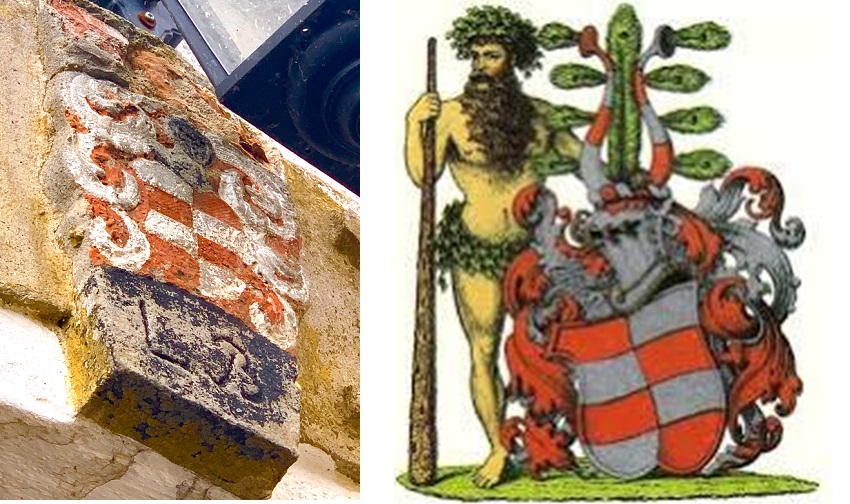
- Dexter (Husband — Bille): Parted per pale: dexter, argent; sinister, gules two fesses argent. Crest: two buffalo horns parted per pale argent and gules, between them a plume of peacock feathers. Supporter: a savage (vildmand) holding a club (Hiort-Lorenzen & Thiset, 1890).
- Sinister (Wife — Marsvin): Argent, on a bend gules a porpoise (marsvin) argent. Crest: seven ostrich plumes alternating argent and gules flanked by tournament flags. Mantling: gules doubled argent (Hiort-Lorenzen & Thiset, 1904).
- Genealogical Note: While Pernille Marsvin and Lave Bille (1607–1679) linked the two dynasties at Dybäck, the initials H. J. B. point to a collateral or subsequent male relative rather than Lave Bille himself.
4. Lower Right Panel (F. R. B. F. O. M. W. — Beck & von Rohr)
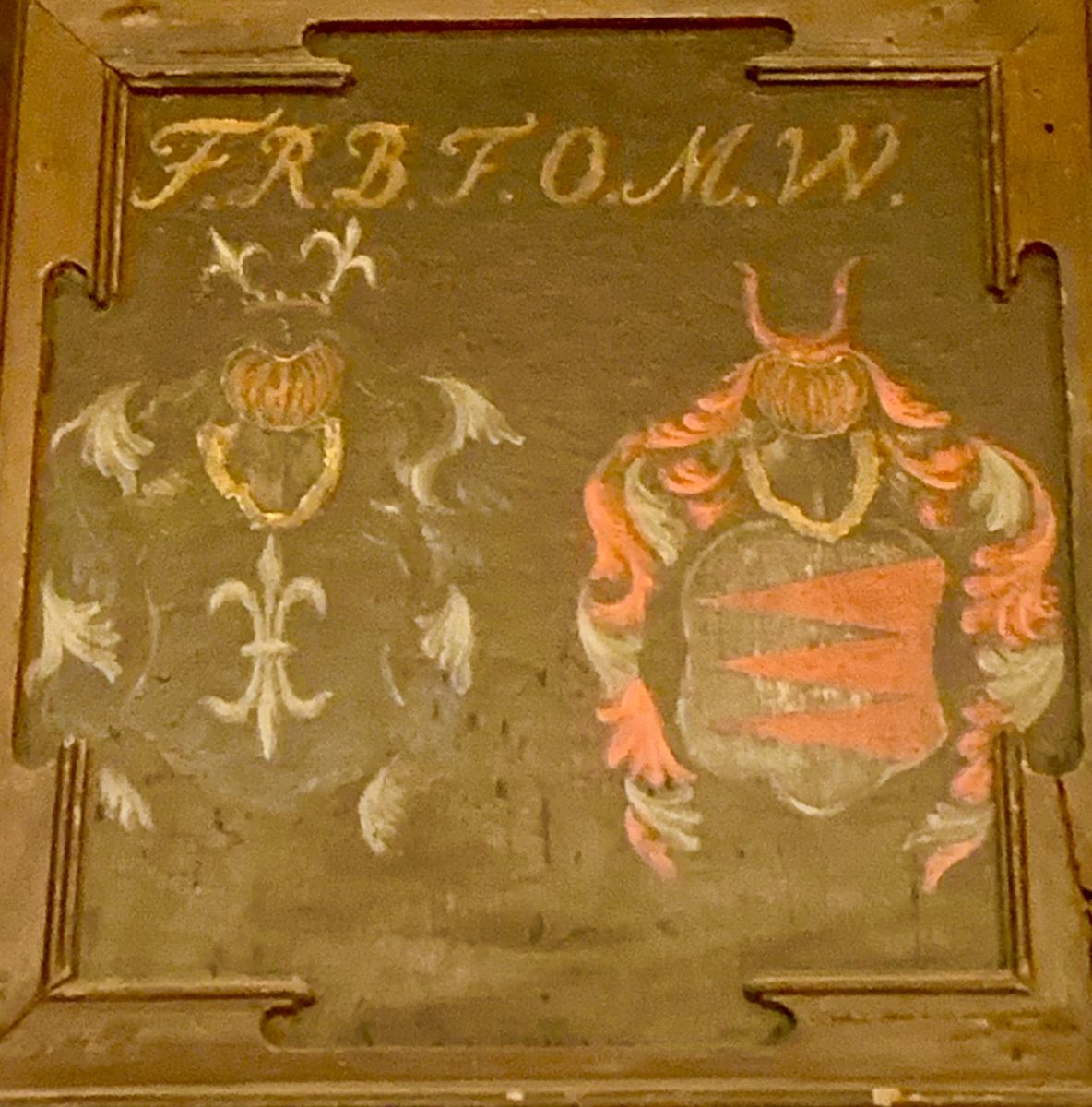
- Dexter (Husband — Beck): Azure, a double lily (Doppellilie) argent. Crest: a crowned helm bearing the same double lily argent between two buffalo horns. Mantling: azure doubled argent (Danmarks Adels Aarbog, 1951; Holbek, 2023; Kasyanenko, 2026). Geographically and genealogically, this Scanian branch of the ancient Beck family held neighboring estates in Vemmenhögs härad—such as Näsbyholm (10 km from Dybäck), Taagerød, Gladsaxe, and Andrarum—and acquired Börringekloster in 1723. Crucially, the depiction of the simple, undivided lily shield proves that the cabinet was painted prior to 1733–1770, when the lineage inherited the Friisenborg fideikommis, adopted the name Beck-Friis, and received baronial (1770) and comital (1771/1791) titles with a far more complex quartered coat of arms (Svenskt biografiskt lexikon, 1922; Riddarhuset, 2026).
- Sinister (Wife — von Rohr): Visually, a black-and-red shield parted per pale indented (im Spitzenschnitt gespalten), with three dark grey-black points on the dexter side directed toward the sinister interlocking with three gules points on the sinister side. Crest: two buffalo horns gules (Büffelhörner). Mantling: gules and dark grey-silver. One must hypothesize, however, that the dark grey-black pigment on the dexter indentations and the inner folds of the mantling is not black enamel (Schwarz), but oxidized silver (Silber)—as silver leaf and silver pigment on 16th–18th-century wooden panels naturally tarnish under varnish and atmospheric sulfur (Kasyanenko, 2026). Accounting for oxidized silver, this matches the classical arms of the noble house von Rohr, whose older Northern European and Scandinavian branches retained the two red buffalo horns (prior to the later adoption of a fox between roses in younger lines) and integrated into Swedish (Von Rohr nr 807, 1672) and Danish nobility (Siebmacher, 1857; Elgenstierna, 1931; Thiset & Wittrup, 1904).
- Epigraphic Note: Both seven-letter inscriptions differ only in their first two characters (H. J. vs. F. R.) while sharing the identical five-letter sequence B. F. O. M. W., pointing to a shared titular or estate formula rather than a surname; without documentary proof, any internal segmentation remains open (Kasyanenko, 2026).
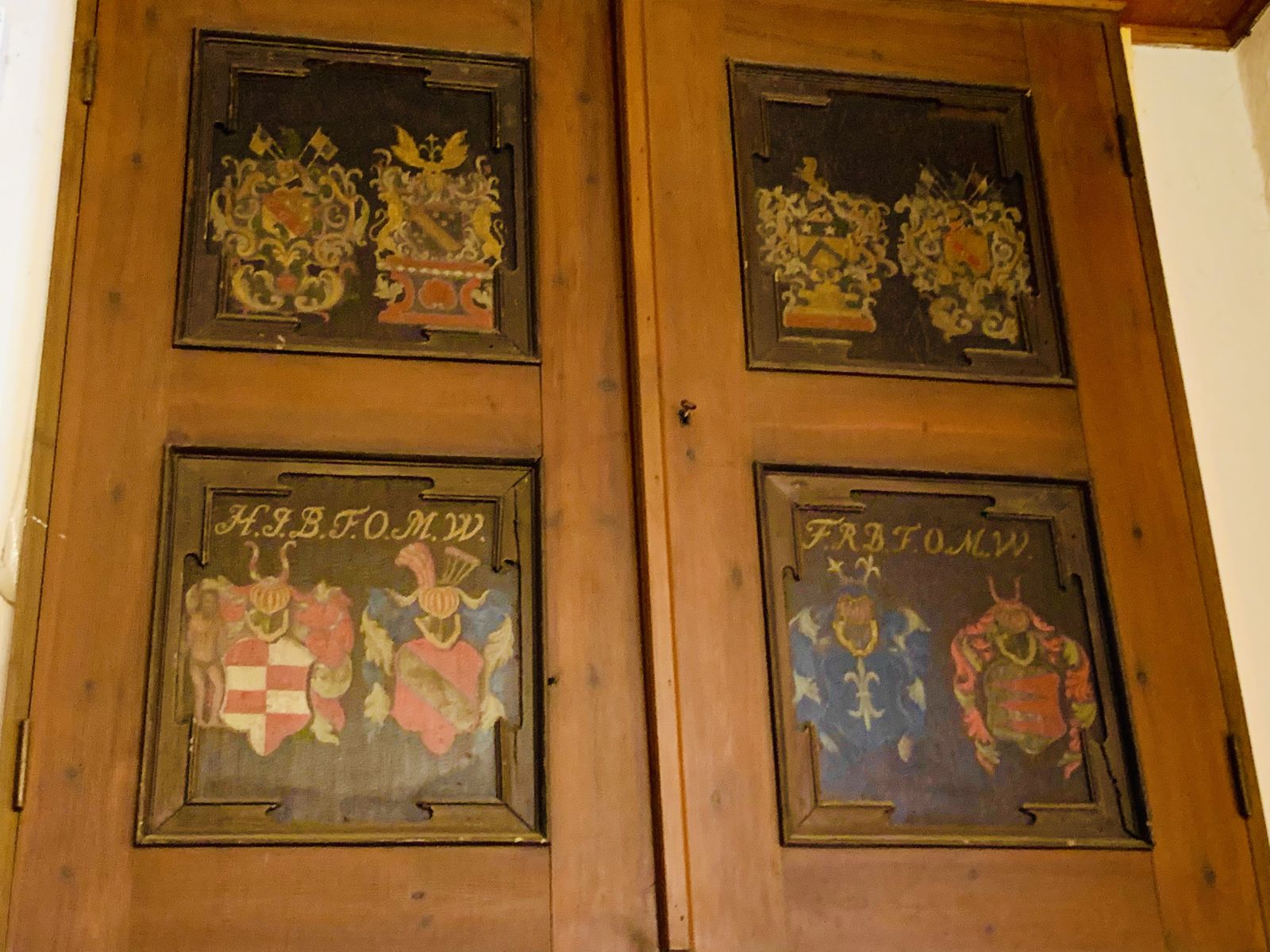
Generational Structure and the Status Counterargument: In classical Ahnentafel logic, the inscribed lower row typically fixes the foundational generation (parents or grandparents), while the uninscribed upper row represents the preceding generation (great-grandparents)—meaning that the Ahnenverlust (repetition of the horseshoe-and-unicorn arms) occurred among the earlier ancestors. However, a compelling status counterargument emerges from the visual hierarchy of the panels: the upper coats of arms are executed with markedly greater ceremonial grandeur—both the upper left sinister shield (with outward-turned lion supporters) and the upper right dexter shield rest upon carved Baroque architectural pedestals (socles), whereas the inscribed lower pairs lack pedestals altogether. This permits two competing hypotheses: either the commissioner descended along the maternal line from an older titled house (placed in the upper ancestral tier), or the upper register represents a later generation of descendants who had already attained higher noble rank, while the lower register records their untitled predecessors (Kasyanenko, 2026).
Exterior Architectural Heraldry & Restoration Inversions
Four exterior artifacts at Dybäck further contrast with the cabinet’s authentic polychromy:
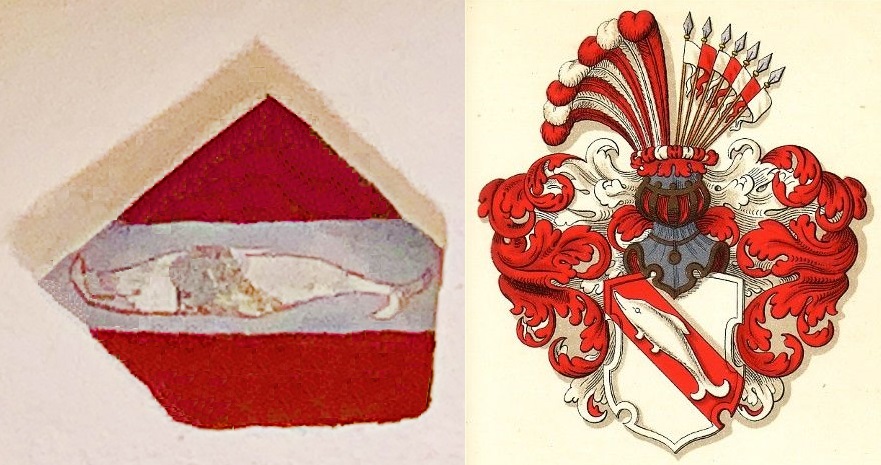
1. Tower Niche Relief (Marsvin Arms): Displays an inverted color scheme—a gules field crossed by a silver fess bearing a porpoise of the same tincture—where a later restoration swapped metal and tincture and altered the bend into a fess (Hiort-Lorenzen & Thiset, 1904; Kasyanenko, 2026).
2. Entrance Cartouche (L. B. — Lave Bille): Carved stone shield above the main portal with inverted tinctures (gules on the dexter, argent with two fesses gules on the sinister), confirming a simultaneous 19th- or 20th-century repainting without heraldic supervision (Hiort-Lorenzen & Thiset, 1890; Kasyanenko, 2026)
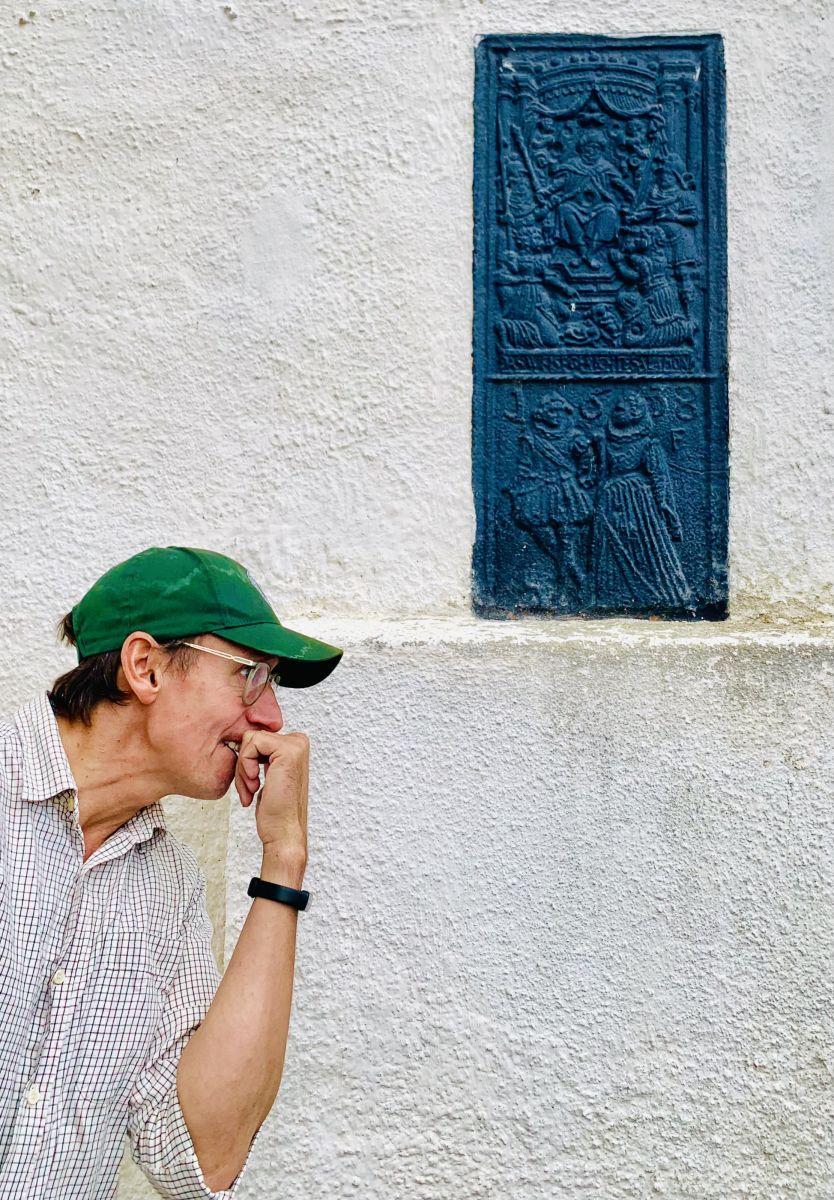
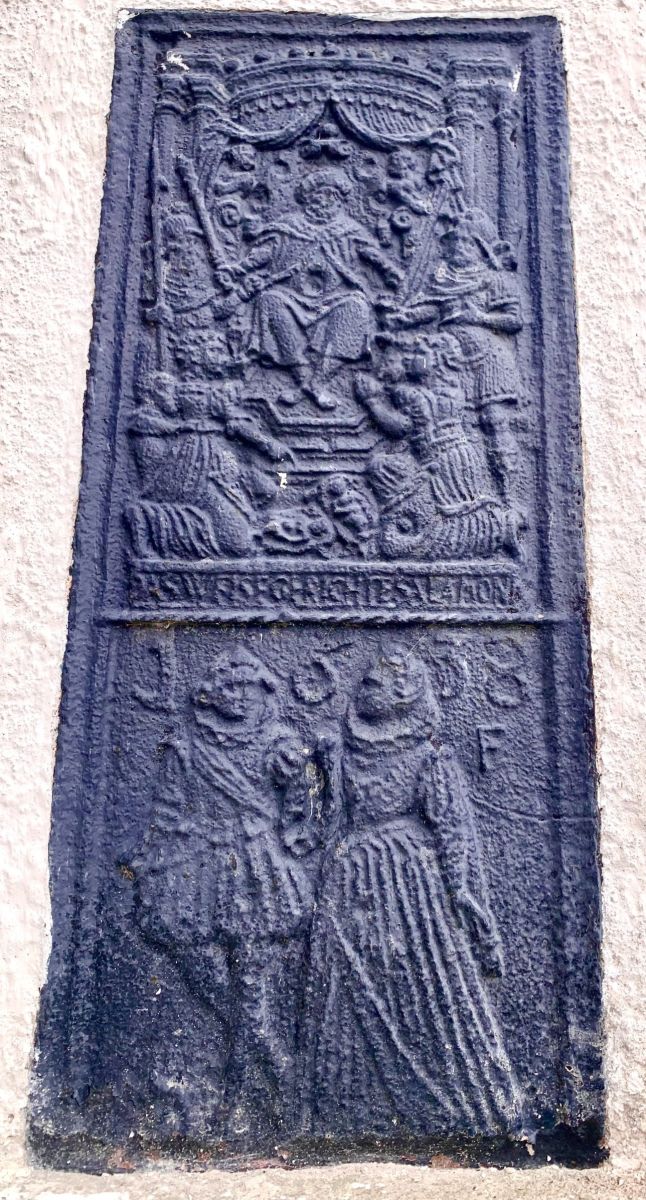
4. 1638 Cast-Iron Stove Plate: Embedded in an exterior wall, bearing the date 1638, a biblical judgment scene, and a noble couple in 1630s attire (with foundry mark F) from Otte Marsvin’s era (Kasyanenko, 2026).
4. 19th-Century Door Tympanum: Neoclassical wooden fanlight featuring an intertwined monogram over an anchor—a civic bomärke (owner’s cypher) typical of post-1857 non-noble owners (Kasyanenko, 2026).
Dating the Cabinet
The "eared" Baroque panel moldings (verkröpfte Rahmen), golden chancellery cursive script, and the pre-1733 undivided Beck arms firmly date the cabinet to circa 1670–1710 (Åberg, 1966; Riddarhuset, 2026; Kasyanenko, 2026).